How to Rank on ChatGPT & Google AI Search in 2026
Published: 26 Oct 2026
On this page
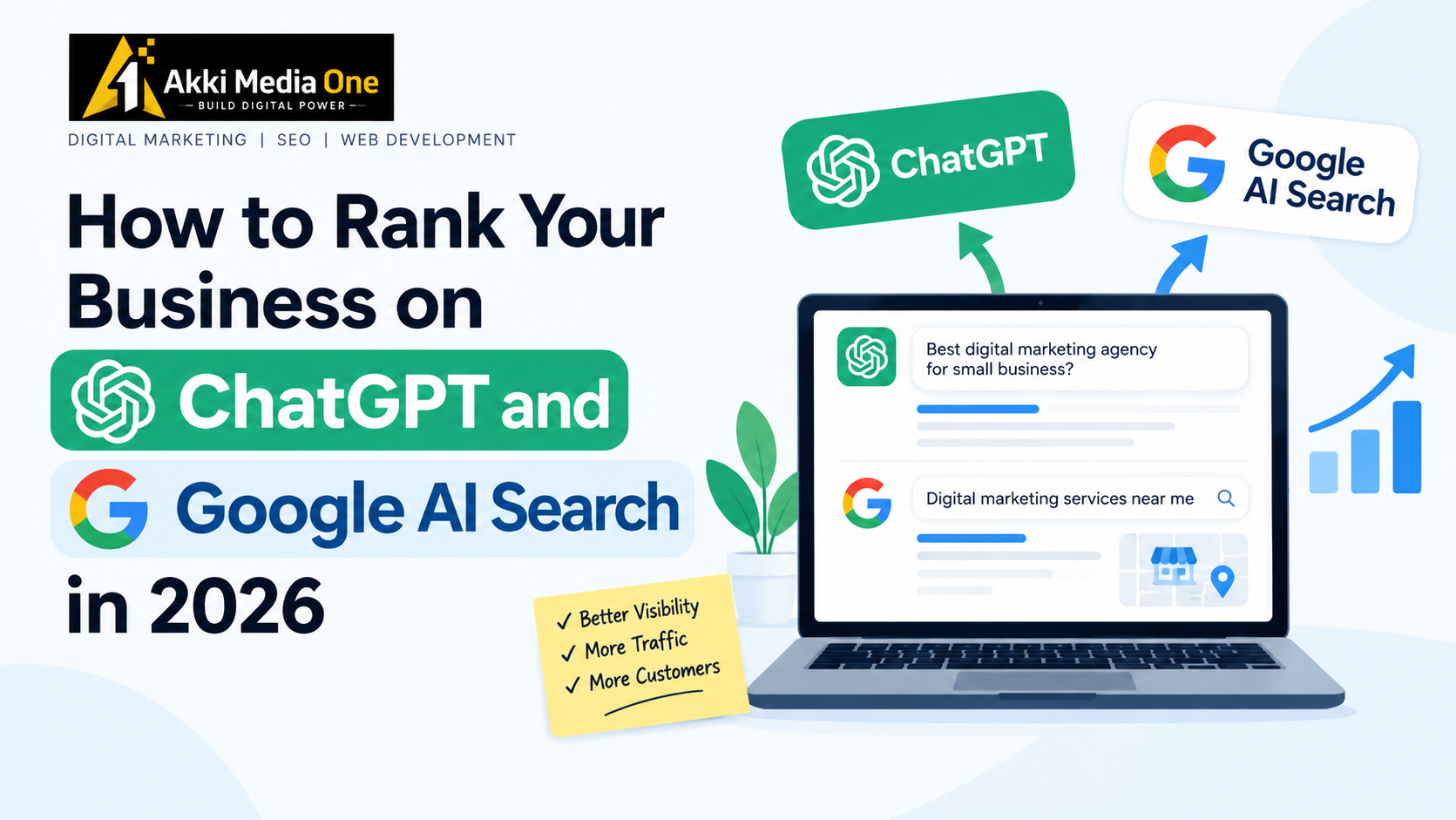
How to Rank Your Business on ChatGPT and Google AI Search in 2026
Published by Akki Media One | SEO & Digital Marketing
Search is changing. People no longer rely only on traditional search results to discover businesses, compare services, and make purchasing decisions. They increasingly use AI-powered experiences such as ChatGPT Search and Google's AI Overviews to explore questions and find useful information.
For businesses, this creates a new opportunity: make your website easy to discover, understand, trust, and recommend through useful information.
However, ranking in AI search is not as simple as adding a few keywords or installing an SEO plugin. Your website still needs strong technical foundations, relevant content, clear business information, and credibility.
In this guide, Akki Media One explains how businesses can improve their chances of appearing in ChatGPT search results and Google AI Search in 2026.
Table of Contents
-
What is AI search optimization?
-
How ChatGPT and Google AI Search work
-
Traditional SEO vs. AI SEO
-
10 practical ways to improve AI search visibility
-
Technical SEO checklist for AI search
-
Local SEO strategies for businesses
-
Common AI SEO mistakes to avoid
-
How to measure your results
-
Frequently asked questions
1. What Is AI Search Optimization?
AI search optimization is the process of improving a website's visibility and usefulness across AI-powered search experiences.
You may also encounter two related terms:
-
Answer Engine Optimization (AEO): Making content useful and easy to interpret when a system needs to answer a specific question.
-
Generative Engine Optimization (GEO): A term used for efforts to improve a brand's visibility in generative AI responses.
These terms describe emerging approaches, but they do not replace traditional search engine optimization.
Google's official guidance explains that established SEO practices remain relevant to AI Overviews and AI Mode. It recommends creating useful, original content, maintaining crawlable pages, and following established search requirements rather than chasing special AI-ranking tricks.
For example, imagine someone asks an AI assistant:
“Which digital marketing agency can help a small business generate leads in India?”
A useful website should clearly explain its services, ideal customers, approach, relevant experience, and how a potential client can get in touch. These details help both human visitors and automated systems understand what the business offers.
The objective is not to manipulate AI answers. It is to build a website that deserves to be discovered.
2. How Do ChatGPT and Google AI Search Work?
Although both use AI, ChatGPT Search and Google's AI-powered search experiences are different products. They do not necessarily select or present the same websites.
ChatGPT Search
ChatGPT can search the web and provide responses with links to relevant sources. Its search visibility depends on multiple factors, and inclusion or placement is not guaranteed. OpenAI explains that website owners should allow its search crawler, OAI-SearchBot, to access their sites if they want their content to be eligible for inclusion in ChatGPT search results.
Google AI Overviews and AI Mode
Google's AI search features can generate responses supported by links to relevant web pages. Eligibility for these features relies on the existing requirements for Google Search, including indexing and the ability to show a page with a snippet.
Google does not require a separate AI-specific markup or special optimization technique to appear in AI Overviews or AI Mode. Following its established SEO and content-quality practices remains the recommended starting point.
What does this mean for your business?
You should build one strong SEO foundation rather than treating every AI platform as an entirely separate search engine.
Focus on four areas:
-
Discoverability: Can search crawlers access your website?
-
Relevance: Does your content directly answer your audience's questions?
-
Trust: Can visitors verify your expertise, business details, and claims?
-
Usability: Is your website fast, mobile-friendly, readable, and easy to navigate?
These are practical priorities, not a formula that guarantees AI citations.
3. Traditional SEO vs. AI SEO: What Is the Difference?
|
Area |
Traditional SEO |
AI search optimization |
|---|---|---|
|
Main objective |
Improve visibility in search results |
Improve visibility and usefulness in AI-powered discovery |
|
Content |
Relevant, high-quality pages |
Relevant pages with clear, useful, well-supported answers |
|
Keywords |
Understand search terms and intent |
Understand questions, context, entities, and related topics |
|
Technical setup |
Crawling, indexing, site structure |
The same foundations, plus attention to the relevant AI search crawler |
|
Authority |
Build credibility and relevant references |
Make business identity, expertise, and claims easy to verify |
|
Measurement |
Rankings, impressions, clicks, conversions |
Traditional metrics plus AI referral traffic and citation checks |
These approaches overlap substantially. AI search should complement your SEO strategy, not replace it.
A business that has poorly structured pages, little useful information, and technical indexing problems should fix those issues before spending money on speculative GEO tactics.
4. 10 Practical Ways to Improve Your AI Search Visibility
1. Create helpful, original content
Publishing many generic blog posts does not automatically improve your visibility.
Instead, create content that solves actual customer problems and provides more value than a basic summary of existing articles.
For example, a digital marketing agency could publish:
-
How much does digital marketing cost for a small business in India?
-
Google Ads vs. Meta Ads: Which is better for lead generation?
-
Why is my website getting traffic but no enquiries?
-
How to measure the ROI of a digital marketing campaign.
-
How to choose a website development company for your business.
Add practical examples, original analysis, relevant screenshots, and explanations based on genuine experience.
Google specifically recommends helpful, reliable, people-first content and warns against producing large volumes of low-value material primarily to manipulate search rankings.
2. Answer important questions directly
Make your content easy to navigate and understand.
Start each major section with a clear answer before expanding into supporting details.
For example:
Question: How can a business improve its visibility on ChatGPT?
Answer: Make your website publicly accessible, allow the relevant search crawler, publish accurate and useful information, maintain strong SEO fundamentals, and build a credible online presence. These steps improve eligibility and usefulness but cannot guarantee that ChatGPT will mention your business.
You can then explain each step in detail.
Use descriptive H2 and H3 headings, short paragraphs, numbered instructions, and comparison tables where appropriate. This improves the reading experience and makes important information easier to locate.
There is no need to force every paragraph into a fixed number of words or follow a supposed special formula for AI citations.
3. Strengthen your website's technical SEO
Before publishing more content, make sure search engines can access your important pages.
Check the following:
-
Important pages return the correct HTTP status.
-
Pages intended to appear in search are not blocked by
robots.txt. -
Unwanted
noindexdirectives are not applied to important pages. -
Canonical tags point to the preferred version of each page.
-
Your XML sitemap includes the correct canonical URLs.
-
Internal links use crawlable HTML links.
-
Mobile users can read and navigate the website comfortably.
-
Important content is available to search systems even when JavaScript is involved.
Use Google Search Console to inspect important URLs, review indexing issues, and submit your sitemap where appropriate.
For official implementation guidance, see Google Search Essentials
4. Check whether ChatGPT's search crawler can access your website
This is an important technical step if you want your website to be eligible for discovery through ChatGPT Search.
Open your website's robots.txt file, normally available at:
https://yourdomain.com/robots.txt
Check whether OAI-SearchBot is explicitly blocked. If you want to allow ChatGPT Search to crawl your public pages, make sure your robots rules permit it and that your hosting provider or content delivery network is not blocking the crawler.
A simplified example of allowing the crawler is:
User-agent: OAI-SearchBot
Allow: /
Important: Do not blindly replace your existing robots.txt file with this example. Preserve other necessary rules and confirm that the relevant paths are accessible.
OpenAI distinguishes OAI-SearchBot, which supports search discovery, from GPTBot, which is associated with crawling for potential model training. These controls are independent. Allowing one does not automatically mean you must allow the other.
Also remember that allowing a crawler does not guarantee indexing, citations, or a particular position in an answer.
5. Build dedicated service pages
Your website should explain each important service on a relevant, dedicated page.
For example, a digital agency might create separate pages for:
-
Search Engine Optimization
-
Google Ads Management
-
Meta Ads Management
-
Website Development
-
E-Commerce Development
-
Lead Generation
-
Local SEO
Each page should explain the service, who needs it, the problems it solves, the process involved, relevant deliverables, and the next step for interested customers.
Avoid creating dozens of nearly identical pages just to target minor keyword variations. Each page should offer distinct value.
For Akki Media One, clear service pages can help potential clients understand the agency's capabilities while supporting a coherent internal-link structure.
6. Demonstrate genuine experience and credibility
Businesses should make it easy for visitors to understand who they are and why their information deserves attention.
Useful trust signals include:
-
A complete About Us page.
-
Accurate business contact information.
-
Clear author names and relevant professional backgrounds.
-
Genuine project case studies.
-
Verifiable testimonials and client feedback.
-
Transparent descriptions of services and processes.
-
Sources for factual claims and statistics.
For example, rather than simply claiming that a marketing campaign delivers excellent results, publish a case study showing the objective, strategy, budget context where disclosure is permitted, measurement method, and actual outcome.
Never invent client names, reviews, credentials, or performance figures.
Google's guidance on helpful content encourages clear authorship, original information, expertise, and trustworthy content.
7. Use structured data correctly
Structured data helps search engines interpret certain types of information about a page.
Depending on your website, relevant schema types may include:
-
Organizationfor business identity. -
LocalBusinessfor eligible local business details. -
ArticleorBlogPostingfor blog content. -
BreadcrumbListfor breadcrumb navigation.
Use only schema types that accurately describe the visible page content. Validate supported markup using Google's Rich Results Test and review the applicable structured data guidelines.
Do not expect schema markup to force an AI system to cite your website. Google states that there are no additional special technical requirements for inclusion in its AI Overviews and AI Mode beyond the existing Search eligibility requirements.
8. Strengthen your local SEO presence
If you serve a specific city or region, make your location and service coverage clear.
Practical steps include:
-
Maintain an accurate Google Business Profile if your business is eligible.
-
Keep your business name, phone number, website, and service information accurate.
-
Create genuinely useful location-specific pages where appropriate.
-
Ask real customers for honest reviews without offering incentives that violate platform policies.
-
Add local project examples and relevant service-area information.
-
Make your contact details and enquiry process easy to find.
For example, an agency serving businesses in Delhi NCR can explain its service coverage and showcase genuine work relevant to that market.
Do not create fake offices or hundreds of thin city pages. Local relevance should reflect your actual business operations.
These steps strengthen your local web presence, although no individual action guarantees a recommendation by ChatGPT or Google AI Search.
9. Build relevant internal and external links
Links help users navigate your website and provide context about the relationships between pages.
A useful internal-link structure might look like this:
-
A blog about Google Ads links to the Google Ads service page.
-
A blog about website costs links to the Website Development page.
-
A project case study links to the service used for that project.
-
A general SEO guide links to related technical SEO and local SEO articles.
Use descriptive anchor text such as “Google Ads management services” instead of repeatedly using vague text like “click here.”
External links should support your claims with reliable sources. Relevant industry coverage, legitimate partnerships, and genuine mentions can also help people discover your business.
Avoid buying links or generating large numbers of irrelevant backlinks. Google's search policies identify link spam as a practice that can undermine search visibility.
10. Keep information accurate and updated
AI search systems and traditional search engines need accessible, relevant information. Visitors also need to know whether your claims and advice are still valid.
Review important pages periodically for:
-
Outdated prices, offers, or service details.
-
Broken links and obsolete instructions.
-
Unsupported statistics.
-
Changed contact details.
-
New examples or lessons from actual projects.
-
Questions customers repeatedly ask.
Update content when you have meaningful new information. Do not change publication dates simply to make an unchanged article appear fresh.
For a 2026 guide, cite current official documentation where platform rules or features may change.
5. Technical SEO Checklist for ChatGPT and Google AI Search
Use this checklist before publishing your AI SEO improvements.
[ ] Important pages are accessible and return the correct status codes.
[ ] Google Search Console is configured and important URLs are inspected.
[ ] An accurate XML sitemap is available.
[ ] Robots rules do not unintentionally block Googlebot or OAI-SearchBot.
[ ] Important pages do not have unwanted noindex directives.
[ ] Canonical URLs and internal links are correct.
[ ] Service pages contain unique, useful information.
[ ] Business identity, contact details and authorship are accurate.
[ ] Relevant structured data matches visible page content.
[ ] The website works well on mobile and loads reliably.
[ ] Analytics and lead-conversion tracking are working.
[ ] Key pages and AI referral traffic are reviewed regularly.
6. How to Track Your AI Search Performance
You cannot improve a strategy reliably if you do not measure what happens after implementation.
Use a combination of established SEO analytics and practical AI visibility checks.
Google Search Console
Monitor:
-
Search impressions and clicks.
-
Queries that bring visitors to relevant pages.
-
Indexing and crawling issues.
-
Performance changes after publishing or updating content.
-
Any available reporting for Google AI search features.
Google's documentation and reporting capabilities can evolve, so consult its current AI features guidance for the latest measurement options.
Google Analytics
Configure analytics to understand how visitors behave after arriving at your website.
Track meaningful outcomes, such as:
-
Contact form submissions.
-
Clicks on phone and email links.
-
Qualified enquiries.
-
Booked consultations.
-
Sales or other conversions relevant to your business.
Where your analytics setup supports it, identify referral traffic from AI platforms and compare its engagement and conversion quality with other channels.
Manual AI visibility checks
Create a small set of questions that your potential customers might ask ChatGPT or other AI search tools.
For example:
-
Which digital marketing agencies help small businesses in India?
-
How should a business choose an SEO agency?
-
What should I compare when selecting a website development company?
-
Which digital marketing strategies can help generate qualified leads?
Test these queries periodically and record whether your business appears, which pages are cited, and which competitors are mentioned.
Results may differ between queries, sessions, regions, and products. Treat these checks as directional observations, not a complete ranking report.
Important: Do not judge success solely by whether an AI mentions your brand. Organic search traffic, qualified leads, conversions, and useful customer engagement remain important business outcomes.
7. Common AI SEO Mistakes to Avoid
Businesses often waste time and money chasing shortcuts that are not supported by official search guidance.
|
Mistake |
Better approach |
|---|---|
|
Publishing hundreds of AI-generated articles without review |
Create fewer, more useful pages with original insights |
|
Stuffing ChatGPT and AI SEO keywords into every paragraph |
Write naturally around the reader's actual questions |
|
Assuming |
Prioritize crawlability, useful content and established SEO |
|
Blocking all crawlers without understanding the impact |
Review access rules based on your publishing and privacy needs |
|
Buying backlinks or fake reviews |
Build genuine authority and customer trust |
|
Adding schema markup to hidden or unrelated content |
Ensure structured data accurately represents the page |
|
Expecting instant AI visibility |
Monitor results over time and improve based on evidence |
|
Claiming guaranteed ChatGPT or Google AI rankings |
Set realistic expectations and report measurable outcomes |
Google's 2026 guide explicitly cautions against relying on supposed AEO/GEO hacks, including unnecessary AI text files, excessive content chunking, and inauthentic mentions.
8. A Practical 30-Day AI SEO Action Plan
You do not need to overhaul your entire website in one day. Start with the pages most likely to help your audience and your business.
Audit your website
Check indexing, robots rules, sitemaps, mobile usability, canonical URLs, and important service pages. Establish a baseline using Search Console and analytics.
Improve your core pages
Update your homepage, About Us page, contact details, and key service pages. Add genuine proof of expertise and clear explanations of your services.
Publish useful supporting content
Publish one or two high-quality articles based on customer questions. Add relevant internal links, credible references, and appropriate structured data.
Measure and refine
Test a set of relevant AI search queries, check indexing, review traffic and conversions, and identify pages that need further improvement.
After 30 days, assess what has been implemented and whether early signals are improving. Meaningful ranking, traffic, and conversion changes may take longer, and there is no guaranteed timeline for AI search visibility.
9. Frequently Asked Questions (FAQs)
1. How can I rank my business on ChatGPT in 2026?
Make your website accessible to ChatGPT Search's crawler, publish useful and accurate information, strengthen your SEO foundations, and maintain a credible online presence. OpenAI confirms that search placement is not guaranteed, even when a website is eligible.
2. How do I get my website featured in Google AI Overviews?
Ensure your pages meet Google Search's technical requirements, can be indexed, and contain relevant, reliable information. Follow established SEO practices rather than relying on special AI markup or ranking tricks. Inclusion is not guaranteed.
3. Is traditional SEO still important for AI search?
Yes. Traditional SEO remains foundational because Google's AI search experiences use its core Search systems. Useful content, crawlability, clear site structure, and good user experience continue to matter.
4. What is the difference between GEO and SEO?
SEO improves a website's visibility in search engines overall. GEO, or Generative Engine Optimization, describes efforts to improve a brand's visibility in generative AI experiences. In practice, many recommended activities overlap, including producing useful content and maintaining strong technical SEO.
5. Does my business need a separate AI SEO strategy?
Not necessarily. Start with your existing SEO strategy and improve content quality, crawlability, business information, and measurement. Add AI visibility monitoring if it supports your business goals. You do not need to rebuild your website solely for AI search.
6. Does adding llms.txt help a website rank on ChatGPT?
There is no official guarantee that adding llms.txt will improve ChatGPT visibility. Google's current AI optimization guidance advises website owners not to rely on unnecessary AI text files as an SEO shortcut. Prioritize established technical and content best practices.
7. How long does AI SEO take to show results?
There is no fixed timeline. Results depend on factors such as crawlability, indexing, competition, content quality, and the search platform. Track implementation, visibility, traffic, and leads over time instead of relying on promised ranking dates.
8. Can a small business appear in AI search results without a large SEO budget?
Yes, it is possible. A small business can improve its eligibility and discoverability through technically accessible pages, useful niche-specific content, accurate business information, and genuine expertise. Paid tools or a large budget do not guarantee AI citations.
9. Can AI search optimization guarantee more customers?
No. Visibility does not automatically translate into leads or sales. Your website must also communicate a compelling offer, establish trust, and make it easy for potential customers to enquire or purchase.
10. Should I hire an SEO agency for AI search optimization?
An agency may help with technical audits, content strategy, service-page optimization, analytics, and ongoing SEO improvements. Choose a provider that explains its methods, reports measurable outcomes, and avoids guarantees of specific AI rankings or citations.
Build a Website That Deserves to Be Discovered
Ranking on ChatGPT and Google AI Search in 2026 is not about finding a secret formula. It is about making your business easier to discover, understand, and trust.
Start with technical SEO. Publish original, useful content. Explain your services clearly. Demonstrate genuine experience. Maintain accurate business information, and measure how your website contributes to enquiries and revenue.
AI search will continue to evolve, but building a useful and credible online presence is a durable investment in your business.
Need help improving your website's SEO and online visibility?
Akki Media One helps businesses strengthen their digital presence through SEO, website development, and digital marketing services.
Visit Akki Media One to explore our services and discuss your business goals.
Your next step: audit your website, identify the most important pages, and start improving them today.
Internal linking suggestions for Akki Media One
Add these contextual links within the article after confirming the relevant pages exist on your website.
|
Suggested anchor text |
Destination |
|---|---|
|
SEO services |
Your SEO service page |
|
Digital marketing services |
Your Digital Marketing service page |
|
Google Ads management |
Your Google Ads service page |
|
Professional website development |
Your Website Development service page |
|
Our portfolio and case studies |
Your Portfolio page |
|
Contact Akki Media One |
Your Contact page |
Suggested URL patterns, if these match your site's actual routes:
-
/services/seo -
/services/digital-marketing -
/services/google-ads -
/services/website-development -
/portfolio -
/contact
Do not publish these as internal links until you confirm the URLs work. Use your existing page slugs if they differ.
Credible external sources
These official resources support the technical and content recommendations in this article.
Google Search Central — AI optimization guide
Official guidance on AI search, helpful content, crawlability, and GEO misconceptions.
Google Search Central — AI features and your website
Eligibility and established SEO requirements for AI Overviews and AI Mode.
Google Search Central — Helpful, reliable, people-first content
Content quality, original information, authorship, and trust.
OpenAI — Overview of OpenAI crawlers
Crawler purposes and the distinction between search discovery and model-training controls.
OpenAI Help Center — Publishers and Developers FAQ
Practical guidance for website owners who want their content to be discoverable in ChatGPT Search.
Why This Topic Matters
This article is designed to give direct, useful answers that business owners and marketing teams can apply in real projects. For broader execution support, explore our services, review our portfolio, or talk to our team.
About The Publisher
Akki Media One publishes practical guidance on SEO, paid ads, website development, digital strategy and business growth. Our content is written to support decision-making, implementation and measurable outcomes.
Quick Answers
What is the main takeaway from How to Rank on ChatGPT & Google AI Search in 2026?
How to Rank Your Business on ChatGPT and Google AI Search in 2026 Published by Akki Media One | SEO & Digital Marketing Search is changing. People no longer rely only on trad...
Who should read this article?
Business owners, marketing teams and growing brands looking for practical SEO, content, ads or web growth guidance.
What should I do next after reading this?
Review related articles, explore relevant services and contact our team if you need implementation support.