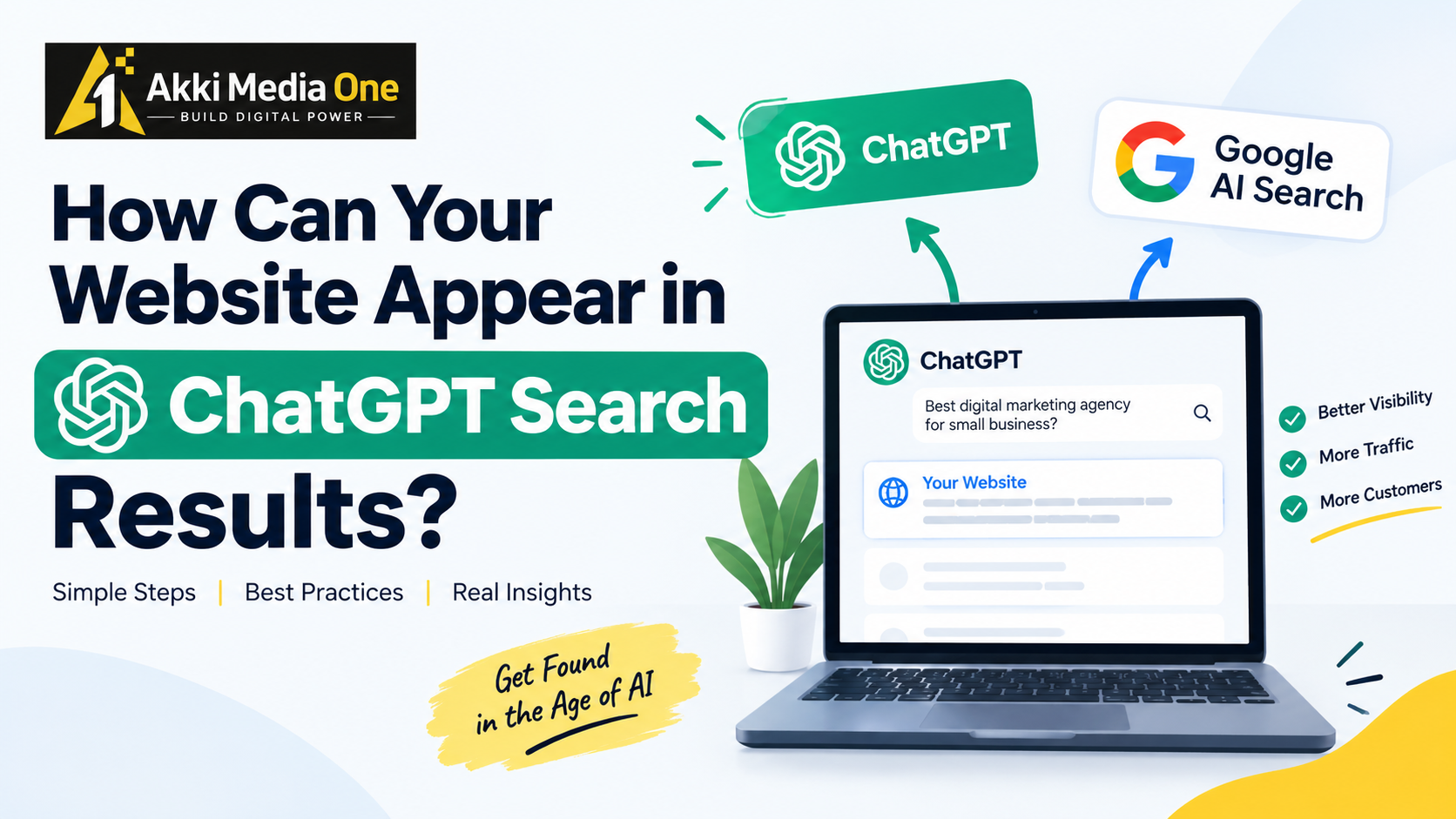
How Can Your Website Appear in ChatGPT Search Results?
Published: 26 Oct 2026
On this page
How Can Your Website Appear in ChatGPT Search Results?
People increasingly use AI-powered search experiences to discover information, compare services, and research businesses. Instead of opening multiple search results, users can ask ChatGPT a question and receive an answer with links to relevant websites.
For businesses, this creates an opportunity to reach potential customers who are actively looking for information, products, and services.
However, appearing in ChatGPT Search is not as simple as adding a few keywords to a website. Your website needs to be accessible to the relevant crawler, provide useful information, and address the user's search intent.
In this guide, Akki Media One explains how ChatGPT Search works, how to make your website eligible for discovery, which technical checks matter, and how to measure your progress using reliable methods.
1. What Is ChatGPT Search?
ChatGPT Search is a search experience that can retrieve information from the web and provide answers with links to relevant sources.
Depending on the question, users can use it to research topics, compare businesses, find services, and explore information from different websites.
For website owners, the objective is to make useful pages accessible and relevant so they can be considered for inclusion in appropriate search experiences.
It is important to understand that ChatGPT does not guarantee that every website will appear in its responses. Even if a website is accessible, its pages may not be selected for a particular question.
Official resource: https://help.openai.com/en/articles/9237897-conducting-your-searches-on-search
2. Can Any Website Appear in ChatGPT Search Results?
Public websites can be eligible for inclusion in ChatGPT Search if they meet the relevant technical and access requirements.
One important technical consideration is OAI-SearchBot, the crawler OpenAI uses to help discover websites for ChatGPT Search.
If you want your public website content to be eligible for ChatGPT Search summaries and citations, check that your robots.txt rules and hosting security settings do not unintentionally block OAI-SearchBot.
However, allowing the crawler does not guarantee that your website will be mentioned, cited, or ranked for a particular query.
Your content must also be relevant to the user's question, and the search system determines which sources to display.
3. How to Make Your Website Discoverable by ChatGPT
Step 1: Allow OAI-SearchBot to Access Your Website
Start by checking your website's robots.txt file.
Open this address in your browser, replacing the example domain with your own:
https://yourdomain.com/robots.txt
Review the existing rules and look for instructions that block OAI-SearchBot from accessing your public content.
If you want to allow this crawler to access all paths, a basic example is:
User-agent: OAI-SearchBot Allow: /
This is only an example rule, not a complete robots.txt configuration. Do not replace your existing file without reviewing its other rules. Keep necessary restrictions for private, administrative, or sensitive pages.
Your hosting provider, firewall, CDN, or anti-bot protection may also block crawler requests. If access is blocked despite your robots.txt settings, investigate those systems too.
Official resource: https://developers.openai.com/api/docs/bots
Step 2: Understand OAI-SearchBot and GPTBot
OpenAI uses different crawler controls for different purposes.
-
OAI-SearchBot: Helps discover websites for ChatGPT Search.
-
GPTBot: Is associated with crawling for potential use in training OpenAI's foundation models.
These controls are independent. Website owners can allow OAI-SearchBot while disallowing GPTBot, depending on their preferences.
If your objective is ChatGPT Search visibility, review OAI-SearchBot access specifically. Allowing one crawler does not automatically allow the other.
Step 3: Make Sure Important Pages Are Accessible
Allowing a crawler in robots.txt is only one part of technical SEO.
Check the following:
-
Important public pages return appropriate HTTP status codes, usually 200 OK.
-
Important content is not unintentionally blocked by robots.txt.
-
Hosting security systems do not incorrectly block legitimate crawlers.
-
Public pages do not require users to log in.
-
Internal links help visitors discover relevant pages.
-
Main content is available as readable text rather than existing only inside images.
These practices improve website accessibility and support general search discoverability, but they do not guarantee ChatGPT inclusion.
4. Create Content That Answers Real Questions
Technical accessibility helps make your website discoverable, but your content must also be useful to your audience.
Think about the questions potential customers ask before making a decision.
For example, someone looking for a digital marketing agency may want to know:
-
How much do digital marketing services cost?
-
Which advertising platform is best for their business?
-
How can they generate qualified leads?
-
What is the difference between SEO and paid advertising?
-
How can they measure marketing performance?
A helpful article should answer these questions clearly instead of repeating the same keywords throughout the page.
Use Clear Headings and Direct Answers
Organize your articles into logical sections with descriptive headings.
Start each section by addressing its main question, followed by explanations, examples, limitations, and supporting evidence.
For example, an article about website development costs could include sections on website types, project scope, hosting, maintenance, and factors that influence pricing.
Clear headings make content easier to navigate and understand. There is no verified heading formula that guarantees a ChatGPT citation.
Publish Original and Useful Information
Improve the value of your content by including:
-
Original project examples and lessons from genuine experience.
-
Transparent comparisons with clear evaluation criteria.
-
Step-by-step instructions that readers can follow.
-
Relevant screenshots, diagrams, and explanatory images.
-
Credible references for technical claims and important facts.
-
Practical limitations, risks, and common mistakes.
Never invent client results, testimonials, qualifications, statistics, or case studies to make an article appear more authoritative.
Accuracy and transparency are more valuable than exaggerated claims.
5. Strengthen Your Website's Traditional SEO
AI search visibility and traditional SEO share many foundational practices.
A technically accessible website with useful content and a clear structure is a stronger starting point than a website with indexing problems or poor-quality information.
Improve Internal Linking
Link related articles and service pages where it helps readers.
For example, this article can link to your SEO services page and other relevant articles about technical SEO, AI search, and website optimization.
Use descriptive anchor text so visitors understand what they will find after clicking a link.
Avoid adding irrelevant links simply to repeat keywords.
Maintain a Clear Website Structure
Use descriptive page titles, appropriate headings, readable URLs, and logical navigation.
Keep important service pages accessible from relevant sections of your website.
An XML sitemap can help search engines discover URLs. Google Search Console can help website owners monitor Google's crawling, indexing, and search performance.
Remember that submitting a sitemap does not guarantee indexing, and Google Search Console does not provide a complete report of ChatGPT rankings.
Use Structured Data Appropriately
Structured data helps search engines interpret certain information about a page when implemented correctly.
Depending on the content, relevant types may include:
-
Organization
-
Article
-
BreadcrumbList
Only use structured data that accurately represents visible page content and follows the relevant guidelines.
Do not assume that schema markup will force ChatGPT to cite your website. No particular schema type guarantees AI search visibility.
6. Build Trust and Make Your Business Information Clear
Visitors should be able to understand who operates your website, what your business offers, and how to verify important claims.
For a business website, consider providing:
-
A clear About Us page.
-
Accurate contact information and service descriptions.
-
Relevant author information for educational articles.
-
Genuine portfolio examples and case studies, where available.
-
Transparent explanations of services and deliverables.
-
Reliable external sources for claims that require verification.
These practices help visitors assess your credibility. They do not guarantee that an AI search system will recommend your company.
7. Does Website Speed Matter for ChatGPT Search?
Website performance is an important part of user experience and general website quality.
Your website should load reliably, work well on mobile devices, and allow visitors to access information without unnecessary friction.
Review your mobile layout, page loading performance, navigation, and enquiry forms. Resolve broken links and server errors that interfere with access.
Do not treat a particular speed score as a guaranteed ChatGPT ranking factor. Focus on providing a reliable experience for visitors and maintaining technical accessibility.
8. How to Check Whether Your Website Can Appear in ChatGPT Search
Use this practical checklist to identify common technical and content issues.
-
Open your robots.txt file and review the rules for OAI-SearchBot.
-
Check whether your hosting provider, firewall, or CDN blocks legitimate crawler requests.
-
Confirm that important public pages are accessible without logging in.
-
Review HTTP status codes, internal links, and unwanted indexing restrictions.
-
Check that your content is useful, original, and relevant to your audience.
-
Test relevant questions in ChatGPT Search and record whether your website is cited.
-
Review analytics for referral traffic from AI search experiences where identifiable.
Search results can vary by query and other factors. Testing a single question once is not enough to establish consistent visibility.
9. How to Measure ChatGPT Search Visibility
Use several signals instead of relying on a single ranking check.
Monitor Relevant Search Queries
Create a list of realistic questions that potential customers might ask.
Test these queries periodically and record whether your business or website appears among the cited sources.
Review Website Referral Traffic
Use your analytics platform to investigate visits referred by AI search services when referral information is available.
Track engagement and conversions, not just the number of visits.
Measure Business Outcomes
Monitor meaningful actions such as:
-
Contact form submissions.
-
Qualified enquiries.
-
Consultation bookings.
-
Phone calls.
-
Sales and other relevant conversions.
A small number of relevant visitors may be more valuable than a large volume of unqualified traffic.
Do not claim that a visitor came from an AI recommendation unless your analytics or another reliable record supports that conclusion.
10. Common ChatGPT SEO Mistakes to Avoid
|
Mistake |
Better Approach |
|---|---|
|
Accidentally blocking OAI-SearchBot |
Review crawler rules and infrastructure settings. |
|
Publishing generic content at scale |
Focus on originality, usefulness, and fact-checking. |
|
Keyword stuffing |
Write naturally around the reader's actual question. |
|
Inventing reviews or client results |
Use genuine evidence and transparent claims. |
|
Relying on unsupported SEO shortcuts |
Follow documented technical requirements and established SEO practices. |
|
Expecting instant results |
Monitor discovery and visibility over time without assuming guaranteed outcomes. |
11. Frequently Asked Questions (FAQs)
Q1. How can I get my website to appear in ChatGPT Search?
Allow OAI-SearchBot to access the public pages you want to make eligible for search, check your hosting and security settings, publish useful content, and maintain sound technical SEO.
These steps support eligibility but do not guarantee that ChatGPT will display or cite your website.
Q2. Is ChatGPT Search optimization different from traditional SEO?
Some technical considerations are specific to ChatGPT Search, such as OAI-SearchBot access.
However, useful content, website accessibility, clear page structure, and accurate information remain important foundations for online discovery.
Q3. Does adding llms.txt guarantee better ChatGPT rankings?
No. There is no official guarantee that adding an llms.txt file will improve your website's placement in ChatGPT Search.
Prioritize documented crawler requirements, useful content, and established SEO practices.
Q4. Can a new website appear in ChatGPT Search?
A new website can be eligible for discovery if it is publicly accessible and meets the relevant requirements.
However, eligibility does not guarantee that a new page will be discovered, selected, or cited for a particular question.
Q5. Should I allow GPTBot to access my website?
That depends on your preferences.
OAI-SearchBot is used for ChatGPT Search discovery, while GPTBot is associated with crawling for potential model training.
Review each crawler's purpose and configure access rules according to your requirements.
Q6. How long does it take to appear in ChatGPT Search?
There is no guaranteed timeline for appearing in ChatGPT Search.
Timing and visibility depend on several factors. Allowing a crawler does not guarantee inclusion or a specific position.
Conclusion
Making your website discoverable in ChatGPT Search starts with a clear technical foundation and content that genuinely helps your audience.
Review crawler access, ensure important pages are accessible, publish accurate information, and maintain a website that visitors can navigate easily.
There is no guaranteed shortcut to ChatGPT visibility. A sustainable approach combines technical accessibility, useful content, credible business information, and ongoing measurement.
If you want to improve your website's search visibility, technical SEO, or digital presence, Akki Media One can help you assess your website and identify practical areas for improvement.
Explore Akki Media One: https://akkimediaone.com/
Learn more about our digital marketing and website development services and take the next step toward improving your online presence.
Official References and Further Reading
-
OpenAI — Publishers and Developers FAQ: https://help.openai.com/en/articles/12627856
-
OpenAI — Overview of OpenAI Crawlers: https://developers.openai.com/api/docs/bots
-
Google Search Central — AI Features and Your Website: https://developers.google.com/search/docs/appearance/ai-features
-
Google Search Essentials: https://developers.google.com/search/docs/essentials
-
Google Search Central — Creating Helpful, Reliable, People-First Content: https://developers.google.com/search/docs/fundamentals/creating-helpful-content
Why This Topic Matters
This article is designed to give direct, useful answers that business owners and marketing teams can apply in real projects. For broader execution support, explore our services, review our portfolio, or talk to our team.
About The Publisher
Akki Media One publishes practical guidance on SEO, paid ads, website development, digital strategy and business growth. Our content is written to support decision-making, implementation and measurable outcomes.
Quick Answers
What is the main takeaway from How Can Your Website Appear in ChatGPT Search Results??
How Can Your Website Appear in ChatGPT Search Results? People increasingly use AI-powered search experiences to discover information, compare services, and research businesses. In...
Who should read this article?
Business owners, marketing teams and growing brands looking for practical SEO, content, ads or web growth guidance.
What should I do next after reading this?
Review related articles, explore relevant services and contact our team if you need implementation support.