
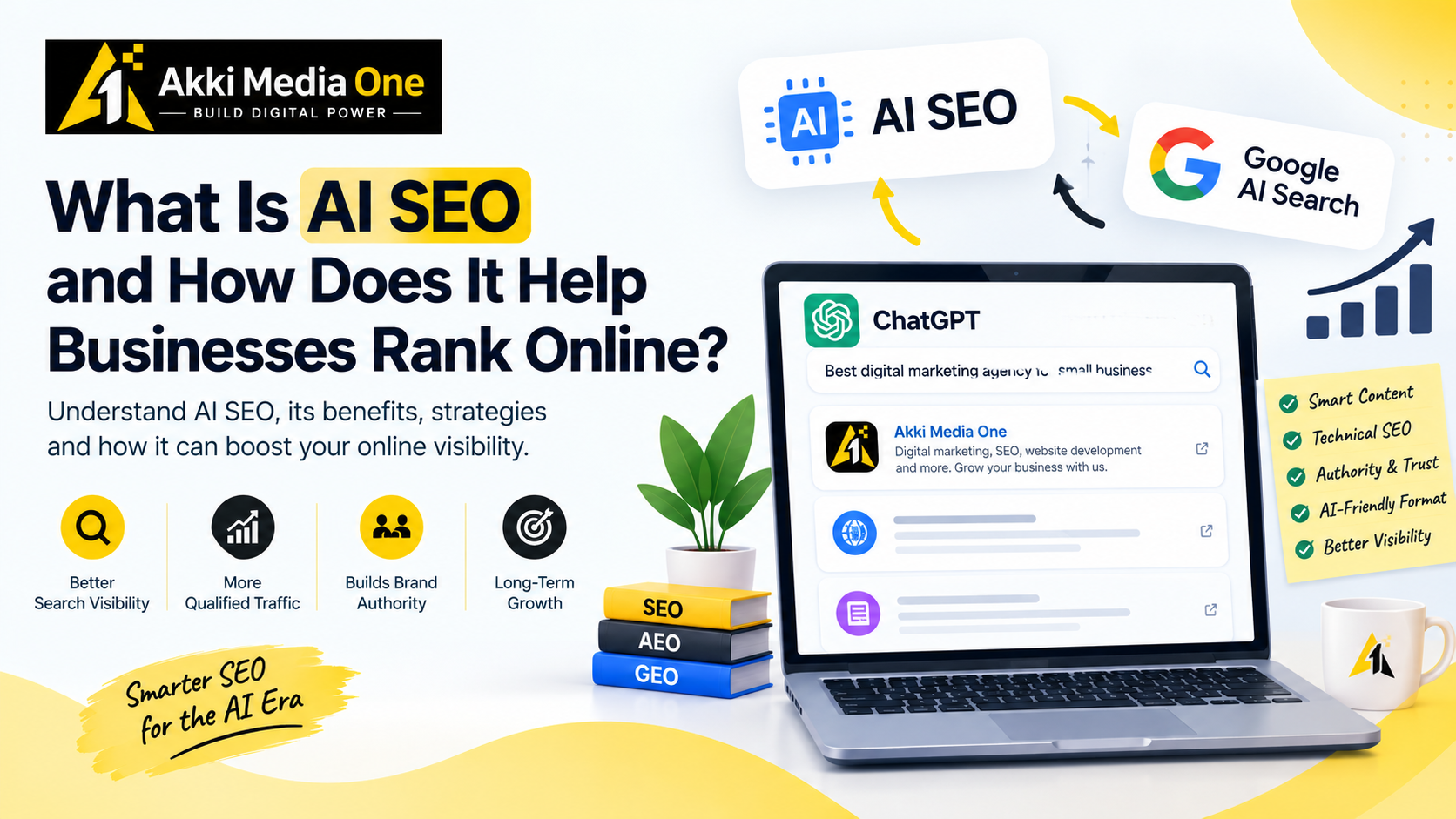
What Is AI SEO and How Does It Help Businesses Rank Online?
Published: 29 Oct 2026
On this page
What Is AI SEO and How Does It Help Businesses Rank Online?
Search engine optimization (SEO) has traditionally focused on helping websites become discoverable in search engines such as Google and Bing. As search experiences evolve, people are also using AI-powered tools to ask questions, compare products, research businesses, and discover solutions.
This change has created growing interest in AI SEO.
But what exactly is AI SEO? Does it require a completely different strategy from traditional SEO? And how can businesses improve their visibility across search engines and AI-powered search experiences?
In this guide, Akki Media One explains AI SEO, its practical applications, the difference between traditional SEO and AI search optimization, and the steps businesses can take to build sustainable online visibility.
1. What Is AI SEO?
AI SEO is a broad industry term for using artificial intelligence to support search engine optimization and adapting website content and technical practices for search experiences that use AI.
The term can refer to two related activities:
-
Using AI in SEO: Applying AI tools to support keyword research, content analysis, topic clustering, technical audits, and other SEO tasks.
-
Optimizing for AI-powered search: Making website content accessible, useful, clear, and relevant so it can be considered in AI-assisted search experiences.
These activities are related, but they are not the same.
For example, an SEO professional may use an AI tool to organize hundreds of keywords into topic groups. Separately, that professional may improve a website's content and technical accessibility to support discovery through AI-powered search experiences.
AI SEO is not a single official ranking system, and there is no universal AI SEO checklist that guarantees visibility across every search engine or AI platform.
The objective is to improve discoverability, help users find accurate information, and build a useful website that serves real search needs.
2. How Does AI SEO Work?
AI SEO combines established SEO practices with appropriate uses of AI tools and an understanding of how search experiences are changing.
The process generally involves five areas.
1. Understanding Search Intent
Search intent is the reason behind a person's search.
For example, someone searching for “what is technical SEO” probably wants an explanation. Someone searching for “technical SEO services” may be comparing providers.
AI tools can help organize search queries and identify common themes, but the conclusions should be checked against actual search results, audience needs, and reliable keyword data.
2. Creating Helpful Content
Businesses need content that answers relevant questions accurately and clearly.
This may include:
-
Detailed educational articles.
-
Practical tutorials.
-
Service explanations.
-
Original research and case studies.
-
Comparisons of products or services.
-
Frequently asked questions.
-
Supporting evidence from credible sources.
AI can assist with research and drafting, but publishing unverified AI-generated content at scale can introduce errors, duplication, and low-value information.
Human review remains important.
3. Improving Technical Accessibility
Search systems need to access and interpret website content to consider it for discovery.
Important technical practices include:
-
Maintaining crawlable public pages.
-
Fixing broken links and server errors.
-
Using a logical website structure.
-
Maintaining appropriate internal links.
-
Providing readable text and descriptive page titles.
-
Reviewing robots.txt rules and relevant crawler access requirements.
-
Implementing structured data correctly where appropriate.
The exact requirements can differ between search engines and AI services.
4. Building Trust and Authority
Businesses should provide accurate information about their services, experience, and expertise.
Useful trust signals may include genuine case studies, transparent company information, credible references, and relevant author expertise.
These elements help users evaluate a business. They do not guarantee that a search engine or AI system will recommend it.
5. Measuring Performance
AI SEO should be evaluated through meaningful results rather than assumptions.
Depending on the platform and available reporting, businesses can monitor organic impressions, clicks, relevant referral traffic, enquiries, conversions, and visibility across selected search queries.
There is no single measurement tool that captures every AI search experience.
3. Traditional SEO vs. AI SEO
Traditional SEO and AI SEO overlap significantly. AI search optimization should generally complement sound SEO practices rather than replace them.
|
Area |
Traditional SEO |
AI SEO and AI Search Optimization |
|---|---|---|
|
Main objective |
Improve discoverability in search engines |
Support discoverability across traditional and AI-assisted search experiences |
|
Content strategy |
Address search intent and provide useful information |
Do the same while making answers, evidence, and context easy to understand |
|
Keyword research |
Identify relevant search terms and demand |
Also examine conversational questions and related topics |
|
Technical SEO |
Crawling, indexing, site structure, performance |
The same foundations, plus attention to relevant AI crawler access requirements |
|
Authority |
Relevant links, reputation, expertise, and useful content |
Credible sources and reputation remain valuable; no universal AI authority formula is established |
|
Measurement |
Impressions, clicks, rankings, conversions |
Traditional metrics plus available AI referral and citation observations |
|
Guaranteed ranking |
No |
No |
An important distinction is that AI SEO is not a replacement for traditional SEO. Many of the same technical and content fundamentals remain useful.
Google's guidance on AI features emphasizes established SEO fundamentals and helpful content rather than a separate set of special optimization requirements for its AI search features.
Official resource: https://developers.google.com/search/docs/appearance/ai-features
4. Why Is AI SEO Important for Businesses?
AI-powered search experiences create additional ways for people to discover information. However, their impact varies by industry, audience, platform, and query.
Businesses can prepare for these changes by improving the quality and accessibility of their online information.
Reach People Asking Detailed Questions
Users may ask conversational questions such as:
-
Which digital marketing strategy suits a small business?
-
How much does website development cost?
-
What is the difference between SEO and paid advertising?
-
How can a business improve the quality of its leads?
Content that addresses these questions can help users understand a topic and evaluate possible solutions.
Improve the Usefulness of Your Website
Working on AI SEO often encourages businesses to improve content organization, clarify service descriptions, verify factual claims, and provide better answers.
These improvements can benefit human readers regardless of whether an AI system cites the page.
Support Brand Discovery
A website may receive visibility through traditional search results, AI-assisted answers, relevant external references, and other online channels.
Being mentioned or cited in an AI-generated answer may introduce a business to a potential customer. However, visibility is not guaranteed, and a mention does not necessarily lead to a website visit or sale.
Identify Content Gaps
AI-assisted analysis can help identify questions that existing website content does not answer adequately.
For example, a web development agency may have a general service page but no explanation of project timelines, maintenance requirements, hosting choices, or pricing factors.
Addressing those gaps can make the website more useful to prospective customers.
5. How to Optimize Your Website for AI Search
Businesses do not need to abandon traditional SEO to prepare for AI-powered search experiences.
The following steps provide a practical starting point.
Step 1: Create Content That Directly Answers Questions
Start by identifying the real questions your audience asks.
For each article:
-
State the main topic clearly.
-
Answer the central question early.
-
Organize supporting information under descriptive headings.
-
Explain technical terms in plain language.
-
Include examples where they improve understanding.
-
Acknowledge limitations and exceptions.
-
Link to credible sources for important factual claims.
Avoid adding unnecessary paragraphs simply to increase word count.
A shorter article that accurately answers a question can be more useful than a longer article filled with repetition.
Step 2: Cover Topics in Appropriate Depth
A single article cannot answer every question about a complex subject.
For example, a website development agency may create related articles about:
-
Website development costs.
-
Choosing a content management system.
-
Website security and maintenance.
-
Landing page optimization.
-
Website speed and performance.
-
SEO fundamentals for new websites.
Link these articles together where it helps readers explore the topic.
This creates a useful content structure and helps visitors discover relevant service pages.
Do not create multiple near-identical articles just to target small keyword variations. Each article should serve a meaningful search intent.
Step 3: Improve Website Technical SEO
Review the technical foundation of your website.
Check that:
-
Important pages can be crawled and are eligible for indexing.
-
Pages return appropriate HTTP status codes.
-
Canonical tags identify the intended version of a page.
-
Internal links lead to relevant, accessible content.
-
XML sitemaps contain appropriate canonical URLs.
-
Mobile users can read and navigate the content.
-
Important content is available as readable text.
-
Unintended robots.txt or security restrictions do not block relevant crawlers.
Use Google Search Console to monitor Google's search visibility and indexing information.
Remember that Google's reporting does not directly measure every AI platform, and indexing in Google does not guarantee a citation in ChatGPT.
Step 4: Use Structured Data Correctly
Structured data provides explicit information about a page to systems that support it.
Depending on your content, relevant schema types may include:
-
Organization.
-
Article.
-
BreadcrumbList.
-
Product, where appropriate and eligible.
Use the appropriate schema type and ensure the markup matches the visible content.
Structured data can help search engines interpret information, but it does not guarantee a featured result, an AI citation, or a particular ranking.
Do not add misleading reviews, unsupported claims, or irrelevant schema properties.
Step 5: Make Your Business Information Clear
For business websites, provide accurate information about the company and its services.
Useful pages may include:
-
About Us.
-
Contact.
-
Services.
-
Portfolio or case studies.
-
Privacy Policy.
-
Relevant author or editorial information.
Use genuine examples and explain the work performed.
If you publish a case study, distinguish measured results from estimates and clearly explain the context. Never fabricate customer testimonials, client names, revenue figures, or campaign outcomes.
Step 6: Review Relevant AI Crawler Requirements
Different AI services may use different crawlers and access policies.
For example, OpenAI documents OAI-SearchBot for helping surface websites in ChatGPT Search and GPTBot for potential model-training purposes. These have distinct purposes and controls.
If you want your website to be eligible for ChatGPT Search, review the current OAI-SearchBot documentation and ensure that your robots.txt and hosting security settings do not unintentionally block the crawler.
Allowing crawler access does not guarantee that your pages will be cited.
Official resource: https://developers.openai.com/api/docs/bots
6. Can AI Tools Help With SEO?
Yes. AI tools can assist with a range of SEO tasks when used appropriately.
|
SEO Task |
How AI Can Help |
What Requires Human Review |
|---|---|---|
|
Keyword research |
Organize keyword lists and identify related themes |
Search demand, competition, and actual intent |
|
Content planning |
Suggest outlines and identify missing topics |
Accuracy, originality, and relevance |
|
Content drafting |
Prepare first drafts and explain concepts |
Fact-checking, editing, and genuine expertise |
|
Technical SEO |
Help interpret reports and explain common errors |
Validate findings and implement fixes safely |
|
Content updates |
Identify outdated sections and possible improvements |
Confirm current facts and avoid unnecessary changes |
|
Reporting |
Summarize trends in supplied data |
Verify calculations and interpret business impact |
AI tools can produce incorrect statements, invented sources, or outdated information. Their output should be treated as a draft or analytical aid, not automatically accepted as fact.
The strongest workflow combines AI assistance with reliable data, expert judgment, and careful quality control.
7. Common AI SEO Mistakes Businesses Should Avoid
AI SEO can be useful, but several approaches can waste resources or damage content quality.
Publishing Large Volumes of Unreviewed AI Content
Using AI to produce many pages without adding meaningful value can create repetitive, inaccurate, or unhelpful content.
Google's policies focus on the quality and purpose of content rather than whether AI was used to create it. Automation intended primarily to manipulate search rankings may violate spam policies.
Assuming AI SEO Guarantees Rankings
No agency or tool can guarantee that a website will appear in every AI-generated answer.
Search systems may select different sources depending on the question, the available information, and their retrieval and ranking processes.
Using Unsupported Ranking Tricks
Avoid claims that a specific keyword density, word count, schema type, or special file guarantees AI citations.
Prioritize documented technical requirements, helpful content, and established SEO fundamentals.
Ignoring Traditional SEO
AI search optimization does not eliminate the need for crawlability, useful page titles, internal linking, relevant content, or a technically sound website.
These remain important foundations of online discoverability.
Measuring Only Traffic
Traffic alone does not establish business value.
A successful strategy should also consider relevant enquiries, qualified leads, conversions, and customer acquisition costs where appropriate.
8. How to Measure AI SEO Performance
AI search measurement is still developing, and available reporting varies by platform.
A practical measurement plan should combine established SEO metrics with observations that can be reliably collected.
Monitor Traditional Search Performance
Use Google Search Console to review:
-
Search impressions.
-
Organic clicks.
-
Click-through rate.
-
Average position for relevant queries.
-
Indexing and crawling issues.
These metrics help evaluate Google Search performance, but they are not a complete measurement of AI visibility.
Observe AI Search Citations
Create a set of relevant questions that prospective customers might ask.
Test them periodically in the AI search experiences relevant to your audience, and record:
-
Whether your business or website appears.
-
Which pages are cited.
-
Whether the cited information is accurate.
-
How often visibility appears across repeated checks.
Search responses can vary. A few manual checks should not be treated as a definitive ranking report.
Monitor Referral Traffic and Conversions
Where analytics data identifies traffic from AI search services, review those visits alongside engagement and conversion data.
Track meaningful outcomes such as enquiries, booked consultations, purchases, and qualified leads.
Do not attribute a conversion to AI search without sufficient evidence.
9. A Practical 30-Day AI SEO Action Plan
The following plan is a starting framework, not a guarantee of rankings within 30 days.
Week 1: Technical review
-
Review important pages and crawling restrictions.
-
Check robots.txt and sitemap configuration.
-
Identify broken links and major indexing issues.
-
Confirm that important service pages are accessible.
Week 2: Content improvements
-
Identify the main questions your audience asks.
-
Improve existing articles that provide incomplete answers.
-
Add credible references for factual claims.
-
Improve headings, internal links, and clarity.
Week 3: Topic coverage and credibility
-
Publish a genuinely useful article addressing an identified content gap.
-
Link it to relevant service pages and supporting articles.
-
Review company information and genuine case studies.
-
Check that structured data accurately reflects the page.
Week 4: Measurement and refinement
-
Review available Google Search Console data.
-
Test relevant questions in selected AI search experiences.
-
Check referral traffic where identifiable.
-
Record the issues that need further work and prioritize them.
The goal of the first month is to establish a reliable process and improve the website's foundations. Rankings and AI citations may take longer, and results are not guaranteed.
10. Frequently Asked Questions About AI SEO
Q1. What is AI SEO in simple words?
AI SEO refers broadly to using AI tools to support SEO work and improving a website's discoverability in AI-powered search experiences. It combines appropriate AI assistance with established SEO practices rather than replacing them.
Q2. Is AI SEO different from traditional SEO?
AI SEO places additional attention on AI-assisted search experiences and may use AI tools for research or analysis. However, technical accessibility, relevant content, clear site structure, and useful information remain important foundations.
Q3. Can AI SEO help a website rank on Google?
AI tools can assist with SEO research, content improvement, and technical analysis. Actual Google rankings depend on Google's systems and many factors. Using AI does not automatically improve rankings.
Q4. How can my website appear in ChatGPT Search?
Review OAI-SearchBot access, ensure public pages are accessible, publish useful content, and maintain sound technical SEO. These practices support eligibility but do not guarantee a mention or citation.
Q5. Does AI-generated content hurt SEO?
AI-generated content is not automatically harmful. Its value depends on accuracy, usefulness, originality, and compliance with search engine policies. Unreviewed content created mainly to manipulate rankings can create problems.
Q6. Do I need to add llms.txt to improve AI SEO?
There is no established guarantee that adding an llms.txt file improves Google rankings or ChatGPT citations. Prioritize documented crawler requirements and established SEO practices instead of relying on unsupported claims.
Q7. How long does AI SEO take to show results?
There is no universal timeline. Technical improvements, content discovery, search visibility, and business results may develop at different rates. Measure progress over time rather than expecting a guaranteed result within a fixed number of days.
Q8. Can small businesses benefit from AI SEO?
Small businesses can benefit from clear service information, helpful educational content, technical SEO, and accurate online business details. The appropriate investment depends on the market, competition, business goals, and available resources.
Conclusion
AI SEO is best understood as an extension of a broader search visibility strategy, not a replacement for traditional SEO.
Businesses can prepare for AI-powered search by making important pages accessible, creating accurate and useful content, improving website structure, and providing trustworthy information about their services.
AI tools can help with research, analysis, and content development, but human review and reliable evidence remain essential.
There is no guaranteed shortcut to appearing in Google, ChatGPT, or other AI search experiences. Sustainable visibility requires useful information, sound technical practices, continuous improvement, and realistic measurement.
Want to improve your website's search visibility?
Akki Media One helps businesses strengthen their online presence through digital marketing, SEO, and website development.
Visit our website: https://akkimediaone.com/
Official Sources and Further Reading
1. Google Search Central — AI Features and Your Website
https://developers.google.com/search/docs/appearance/ai-features
2. Google Search Central — Creating Helpful, Reliable, People-First Content
https://developers.google.com/search/docs/fundamentals/creating-helpful-content
3. Google Search Essentials
https://developers.google.com/search/docs/essentials
4. OpenAI — Overview of OpenAI Crawlers
https://developers.openai.com/api/docs/bots
5. Google Search Central — Introduction to Structured Data
https://developers.google.com/search/docs/appearance/structured-data/intro-structured-data
Why This Topic Matters
This article is designed to give direct, useful answers that business owners and marketing teams can apply in real projects. For broader execution support, explore our services, review our portfolio, or talk to our team.
About The Publisher
Akki Media One publishes practical guidance on SEO, paid ads, website development, digital strategy and business growth. Our content is written to support decision-making, implementation and measurable outcomes.
Related Blogs
Quick Answers
What is the main takeaway from What Is AI SEO and How Does It Help Businesses Rank Online??
What Is AI SEO and How Does It Help Businesses Rank Online? Search engine optimization (SEO) has traditionally focused on helping websites become discoverable in search engines su...
Who should read this article?
Business owners, marketing teams and growing brands looking for practical SEO, content, ads or web growth guidance.
What should I do next after reading this?
Review related articles, explore relevant services and contact our team if you need implementation support.