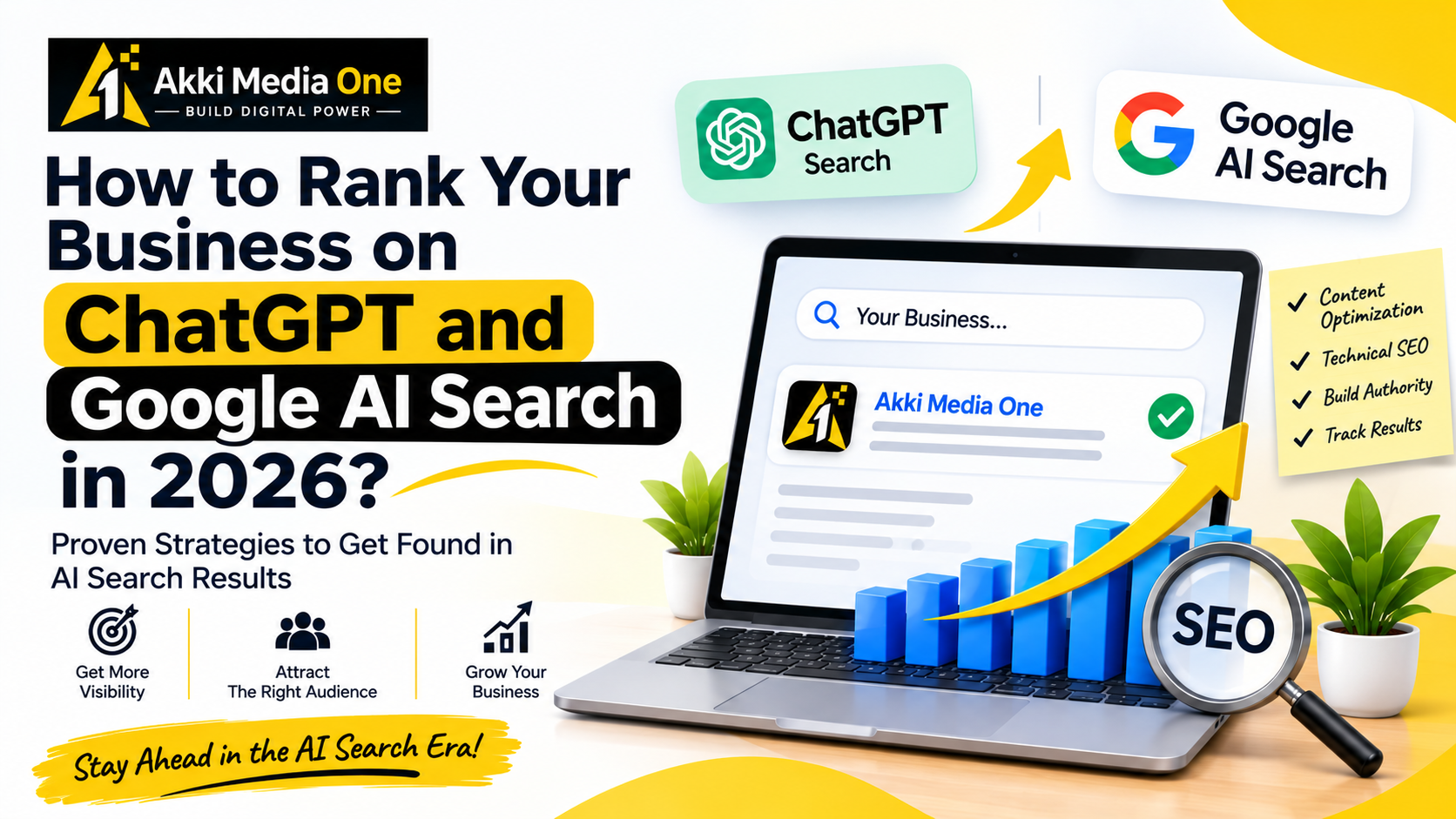
How to Rank Your Business on ChatGPT and Google AI Search in 2026
Published: 30 Oct 2026
On this page
How to Rank Your Business on ChatGPT and Google AI Search in 2026
Search is changing. People are no longer relying only on traditional search results to discover businesses, compare services, and find answers to their questions. They are increasingly exploring AI-powered search experiences that summarize information, recommend sources, and provide links to relevant websites.
For businesses, this creates an important opportunity: making their websites useful, accessible, and trustworthy for both people and search systems.
But how can you improve your chances of appearing in ChatGPT Search and Google AI Search? Is traditional SEO still important? Do you need special AI optimization techniques?
The answer is that strong SEO fundamentals remain essential, but businesses should also understand how AI search systems discover content, evaluate relevance, and present sources.
In this guide, Akki Media One explains practical ways to improve your website's visibility in AI-powered search, strengthen your online presence, and build a sustainable search optimization strategy.
Important: No agency, tool, or SEO technique can guarantee that your business will appear in every AI-generated answer. Visibility depends on factors such as the user's query, available sources, relevance, technical accessibility, and each platform's systems.
1. What Is AI Search and How Does It Work?
AI search uses artificial intelligence to help people find, interpret, and explore information.
Traditional search engines commonly present a list of relevant webpages. AI-powered experiences can also generate summaries, combine information from multiple sources, and provide links that help users investigate a topic further.
Examples include:
-
ChatGPT Search
-
Google AI Overviews
-
Google AI Mode
-
Other AI-powered search and answer experiences
These products do not all work identically, and their results can change depending on the question, available information, and search context.
For example, someone might ask:
-
Which digital marketing agency helps small businesses improve online visibility?
-
How much does a professional business website cost?
-
What should I check before hiring an SEO company?
-
Which website development technologies are suitable for an e-commerce store?
An AI-powered search experience may provide a summarized answer and link to relevant sources.
If your website contains accurate, useful information that answers the user's question, it may have an opportunity to be discovered or cited. However, publishing relevant content alone does not guarantee inclusion.
Google's official guidance confirms that its AI search features continue to rely on established SEO fundamentals, including technical accessibility and helpful content.
2. Why Is AI Search Visibility Important for Businesses?
Potential customers use different methods to research products and services.
Some search for a business name directly. Others compare several providers, research a problem, or ask questions before making a purchasing decision.
Being discoverable across relevant search experiences can create additional opportunities for your business to reach these people.
Potential benefits of AI search visibility
Greater discovery opportunities
Your website may be surfaced when its content is relevant to a user's question.
More opportunities to demonstrate expertise
Detailed service pages, educational articles, and genuine case studies can help explain what your business does and how it solves customer problems.
Support for customer research
Useful information can help prospective customers understand their options before contacting your business.
Potential referral traffic
Some AI search experiences provide links to sources, giving users a way to visit the original website.
Stronger brand understanding
Clear and consistent information across your website and legitimate business profiles can help people understand your services.
These are potential benefits, not guaranteed outcomes. AI search visibility does not automatically translate into more traffic, leads, or sales.
3. How Can Your Website Appear in ChatGPT Search Results?
Start with the technical and content fundamentals that allow search systems to discover and understand your website.
OpenAI's official crawler documentation explains that OAI-SearchBot is used to help surface websites in ChatGPT search results. Website owners can manage crawler access through their site's robots.txt configuration.
Step 1: Check whether OAI-SearchBot can access your website
Open your robots.txt file, usually available at:
https://yourdomain.com/robots.txt
Replace yourdomain.com with your actual domain.
Review the rules carefully to see whether they block OAI-SearchBot from crawling the pages you want to make discoverable.
For example, a rule that disallows the entire site for a particular crawler can prevent that crawler from accessing your pages.
Do not blindly replace your existing robots.txt file. It may contain important rules for other crawlers or private website areas.
If you need to allow ChatGPT search crawling, follow OpenAI's official crawler documentation and make the appropriate change for your site's setup.
Important distinction: OAI-SearchBot is used for search discovery. GPTBot relates to crawling associated with model training. OpenAI documents these as separate controls, so decide which permissions you want rather than treating them as interchangeable.
Step 2: Make important pages publicly accessible
Check that your public service pages, blog articles, and other relevant content can be accessed without a login.
Review potential restrictions such as:
-
Robots.txt disallow rules.
-
Accidental
noindexdirectives. -
Server-level blocking.
-
Authentication requirements.
-
CDN or firewall rules that prevent legitimate crawlers from accessing pages.
-
Broken URLs and redirect problems.
A page being publicly accessible does not guarantee that it will be crawled or included in an AI answer.
Step 3: Publish useful answers to real questions
Create content that helps users understand a topic rather than repeating keywords.
For example, a website development agency could publish articles about:
-
Website development costs.
-
Choosing between WordPress and custom development.
-
Website maintenance requirements.
-
How to evaluate a development proposal.
-
Common website performance problems.
Explain the topic clearly, use accurate information, and provide relevant examples.
Step 4: Keep your business information consistent
Ensure your business name, services, contact information, and other important details are accurate on your website.
If your business has public profiles or listings, review them periodically and correct outdated information.
Consistent information helps customers understand your business, although it does not guarantee an AI recommendation.
Step 5: Monitor discovery and referral traffic
Review your website analytics and available referral data for traffic from AI platforms.
Where a platform provides relevant reporting, use it to understand whether visitors are discovering your content through AI search.
Do not assume that every AI mention produces a website visit or that every referral can be identified reliably in analytics.
4. How Can You Optimize Your Website for Google AI Search?
Google's official guidance states that the same foundational SEO practices apply to AI Overviews and AI Mode. There are no additional special technical requirements or separate AI-specific schema rules that guarantee inclusion.
This means businesses should first make sure their websites follow established SEO practices.
Focus on these areas
1. Crawlability and indexing
Make sure important pages can be crawled and are eligible for indexing.
Use Google Search Console to inspect URLs, review indexing information, and submit your sitemap where appropriate.
2. Helpful content
Publish original, accurate, and useful information that addresses your audience's needs.
3. Internal linking
Connect related articles and service pages with descriptive links so visitors and search systems can discover relevant content.
4. Mobile usability and page experience
Make the website usable across devices and address technical performance issues that affect visitors.
5. Text accessibility
Ensure important information is available as readable text rather than existing only inside images or inaccessible interactive elements.
6. Structured data
Use relevant structured data where appropriate and ensure it accurately represents the visible page content.
Structured data can help search engines understand content in supported contexts, but it does not guarantee AI citations or rankings.
7. Accurate business information
Keep relevant business information and eligible business profiles up to date.
These practices help create a technically sound foundation for traditional and AI-powered search.
5. Create Content That AI Search Systems Can Understand
One of the most practical ways to strengthen search visibility is to organize information clearly.
Your content should make sense to human readers first. Clear organization can also make important information easier for automated systems to interpret.
Use descriptive headings
Choose headings that accurately describe what the section covers.
For example:
-
What Is AI SEO?
-
How Does Website Indexing Work?
-
How Can a Business Improve Its Local Search Visibility?
-
What Factors Affect Website Development Cost?
Avoid vague headings that do not tell readers what to expect.
Answer the main question directly
If a user asks how to improve website visibility, begin with a concise explanation before expanding into detailed guidance.
Then provide supporting details, examples, and relevant limitations.
Use lists and tables when they genuinely help
Lists are useful for steps, requirements, and checklists.
Tables can help readers compare technologies, services, pricing structures, or options.
Do not turn every paragraph into a list simply to make the content appear optimized for AI.
Explain technical concepts in plain language
For example:
“Indexing is the process by which a search engine stores and organizes information about a webpage so that it can potentially appear in search results.”
A clear explanation is more useful than excessive jargon.
Include evidence and credible sources
When discussing technical recommendations, statistics, regulations, or platform requirements, link to authoritative sources.
Do not invent data, claim that an experiment was performed when it was not, or present assumptions as established facts.
Google recommends helpful, reliable, people-first content that demonstrates accuracy, originality, and a clear purpose.
6. Why Original Content Matters More Than Keyword Stuffing
Repeating a keyword many times does not make an article more valuable.
A page that repeatedly uses “best AI SEO agency” without providing useful information may be less helpful than a page that explains the services offered, relevant experience, project process, and limitations.
Instead, focus on answering the user's actual questions.
For example, a digital marketing agency writing about SEO services could explain:
-
What an SEO campaign includes.
-
How technical problems are identified.
-
How keyword research informs content planning.
-
How organic performance is measured.
-
What affects the time needed to see results.
-
Which outcomes cannot be guaranteed.
If you have genuine project experience, include accurate examples and clearly explain what was done and what results were observed.
Never manufacture case studies, customer testimonials, rankings, or performance statistics.
7. Build Trust With Genuine Experience and Clear Business Information
AI search visibility is not simply a matter of publishing more articles.
A business website should also help potential customers understand who operates the business, what it offers, and why its information is credible.
Strengthen your website's trust signals
About Us page
Explain the company's actual background, services, and business focus.
Service pages
Describe the work you provide, your process, deliverables, and relevant limitations.
Portfolio and case studies
Show genuine projects with accurate descriptions of the work completed.
Author information
Identify article authors or reviewers where appropriate and provide accurate information about their relevant experience.
Contact information
Provide legitimate contact details and a clear way for prospective customers to reach your business.
Privacy policy
Explain how your website handles personal information, particularly when collecting enquiries or running lead-generation campaigns.
Updated information
Review articles and service pages when relevant details change. Update content because it needs updating, not simply to make it appear new.
These practices help readers evaluate your business and support a more credible online presence.
8. AI SEO vs Traditional SEO: What Is the Difference?
AI SEO is commonly used to describe efforts to improve a website's visibility in AI-powered search and answer experiences.
The term does not represent a universally standardized ranking system, and it should not be treated as a replacement for traditional SEO.
|
Area |
Traditional SEO |
AI Search Optimization |
|---|---|---|
|
Main objective |
Improve visibility in conventional search results |
Improve opportunities for discovery and citation in AI-powered experiences |
|
Content |
Relevant, useful pages addressing search intent |
The same fundamentals, with especially clear and well-supported answers |
|
Technical foundation |
Crawling, indexing, page quality, and internal links |
The same fundamentals, plus platform-specific access considerations where relevant |
|
Measurement |
Search impressions, clicks, rankings, and conversions |
Available AI referrals, citations or mentions, alongside business outcomes |
|
Guaranteed rankings |
No |
No |
The two approaches overlap substantially.
For Google AI features, Google explicitly advises site owners to continue using established SEO best practices.
For ChatGPT Search, crawler accessibility and relevant content are important considerations, but they do not guarantee that a page will be selected as a source.
The sensible strategy is to build a strong website that serves people well and meets the technical requirements of the search platforms you want to reach.
9. Does Schema Markup Help You Rank in AI Search?
Schema markup is structured data that helps describe information on a webpage in a format search engines can interpret.
Depending on the page, appropriate structured data may describe an organization, article, product, or other supported entity.
For example, an article page might use Article structured data to identify its headline, author, and publication information where those properties are accurate.
However, schema markup should not be treated as a shortcut to AI rankings.
Google's AI search guidance states that no special AI-specific schema markup is required for inclusion in AI Overviews or AI Mode. It also emphasizes that structured data should match the visible page content.
Practical recommendations:
-
Use only relevant schema types.
-
Ensure the markup accurately reflects visible content.
-
Follow the applicable search engine guidelines.
-
Test structured data with appropriate validation tools.
-
Avoid adding unsupported claims or misleading properties.
Implement structured data to improve clarity and support eligible search features, not as a promise of AI visibility.
10. Common Mistakes That Can Hurt Your AI Search Strategy
Mistake 1: Believing AI Search Rankings Can Be Guaranteed
No legitimate SEO process can guarantee that a particular website will appear in every ChatGPT answer or Google AI search experience.
Be cautious of providers selling guaranteed citations or fixed AI rankings.
Mistake 2: Blocking Important Crawlers Accidentally
Review your robots.txt file and relevant server or CDN restrictions.
If ChatGPT search discovery is a goal, check the official guidance for OAI-SearchBot.
Mistake 3: Publishing Large Amounts of Low-Value Content
Publishing many similar articles without original value can waste resources and create a poor experience for visitors.
Prioritize content that answers genuine customer questions.
Mistake 4: Ignoring Traditional SEO
AI search optimization does not eliminate the need for crawlable pages, useful content, internal links, and sound technical implementation.
Mistake 5: Using Fake Statistics and Testimonials
False claims can damage credibility and mislead customers.
Use verifiable evidence and clearly label estimates or examples.
Mistake 6: Ignoring Website Conversion Performance
Being discovered is only one part of the customer journey.
Your website must also explain your services, provide relevant information, and make it easy for suitable prospects to contact you.
Mistake 7: Measuring Only Traffic
More traffic does not necessarily mean more qualified leads or revenue.
Review the quality of enquiries, conversion rates, and business outcomes where reliable data is available.
11. How to Measure Your AI Search Visibility
AI search reporting is not identical across platforms, and not every mention or citation will be measurable.
You can still establish a practical measurement process.
Step 1: Track conventional search performance
Use Google Search Console to monitor:
-
Search impressions.
-
Clicks.
-
Search queries.
-
Average position.
-
Page-level performance.
-
Indexing issues.
These metrics help you understand your website's performance in Google Search, though they do not independently explain every AI-generated appearance.
Step 2: Monitor referral traffic
Use your analytics platform to review traffic arriving from AI search products where the source is identifiable.
Compare relevant landing pages, engagement, enquiry activity, and conversion outcomes.
Step 3: Check representative questions
Periodically test a consistent set of relevant customer questions in the AI search products your audience uses.
Record whether your business or pages appear, which sources are cited, and how results vary.
This is a manual sampling method, not a comprehensive ranking report. Results may differ by query, time, location, and search context.
Step 4: Connect visibility with business outcomes
Where possible, connect website visits to meaningful actions such as enquiry submissions, calls, or consultation bookings.
Do not attribute a sale to AI search without supporting evidence.
Step 5: Improve based on what you learn
Review pages that receive relevant traffic, questions that remain unanswered, and technical problems that prevent discovery.
Make changes that improve usefulness and accessibility rather than chasing every change in AI search results.
12. A Practical 30-Day AI SEO Action Plan
Here is a realistic starting framework for a business that wants to improve its search readiness.
Week 1: Technical Review
-
Review robots.txt and indexing settings.
-
Check important pages in Google Search Console.
-
Inspect internal links and broken URLs.
-
Review access for relevant search crawlers.
-
Check mobile usability and page performance.
Week 2: Content Improvement
-
Identify the questions your target customers actually ask.
-
Improve important service pages.
-
Update outdated or inaccurate information.
-
Organize content with descriptive headings.
-
Add credible references where they support the content.
Week 3: Business Credibility
-
Review your About Us and Contact pages.
-
Improve genuine portfolio examples and case studies.
-
Verify business information across relevant profiles.
-
Check appropriate structured data.
-
Ensure enquiry forms and calls to action work correctly.
Week 4: Measurement and Refinement
-
Review search performance in Search Console.
-
Record a baseline for selected AI search queries.
-
Examine identifiable referral traffic.
-
Review enquiry quality and conversion performance.
-
Prioritize the next improvements based on evidence.
This plan establishes a foundation; it does not guarantee a ranking, citation, or traffic increase within 30 days.
13. Frequently Asked Questions
Q1. How can I rank my business on ChatGPT Search?
Make sure important public pages are accessible, review whether OAI-SearchBot is blocked, publish useful and accurate content, and maintain a technically sound website. These steps can improve discoverability, but they do not guarantee inclusion in ChatGPT answers.
Q2. How can my website appear in Google AI Overviews?
Follow Google's established SEO guidance, including crawlability, indexability, helpful content, internal linking, and a good user experience. Google does not require special AI-specific schema markup or a separate optimization system for AI Overviews.
Q3. Is AI SEO different from traditional SEO?
AI SEO generally refers to improving discoverability in AI-powered search experiences. It overlaps significantly with traditional SEO, including content quality, technical accessibility, and website structure.
Q4. Do I need to add a special AI file to my website?
Google's published guidance says that new AI-specific machine-readable files are not required for inclusion in AI Overviews or AI Mode. For ChatGPT Search, review OpenAI's crawler documentation and make sure the relevant pages are accessible to OAI-SearchBot if you want to allow search discovery.
Q5. Does publishing AI-generated content help a website rank?
AI-generated content does not automatically rank well or poorly simply because AI was used. Quality, accuracy, originality, usefulness, and compliance with search policies matter. Publishing content primarily to manipulate rankings without providing value can be problematic.
Q6. How long does it take to appear in AI search results?
There is no universal timeline. Discovery and inclusion depend on crawling, indexing, relevance, source selection, and the systems used by each platform. A website may be technically eligible without appearing in a particular answer.
Q7. Can an SEO agency guarantee AI search visibility?
No agency can legitimately guarantee a particular citation or position across AI-generated answers. An agency can improve technical readiness, content quality, and measurement, but final selection is controlled by the platform.
Q8. How can I check whether ChatGPT is crawling my website?
Review your robots.txt rules, relevant server or CDN restrictions, and available server logs. Compare the crawler identity with OpenAI's official documentation rather than assuming every bot claiming to be an AI crawler is legitimate.
Conclusion
Improving your business's visibility in ChatGPT and Google AI Search begins with a strong foundation: accessible webpages, accurate information, helpful content, clear website structure, and credible business details.
There is no guaranteed shortcut to AI search visibility. Instead of relying on keyword stuffing, unsupported ranking claims, or special markup promises, invest in a website that answers real questions and helps customers make informed decisions.
Continue monitoring conventional search performance, investigate available AI referral data, and improve your website based on evidence.
For businesses looking to strengthen their digital presence, combining sound SEO practices with useful content and a well-structured website provides a more sustainable approach than chasing short-term ranking tricks.
Want to improve your website's search visibility?
Akki Media One provides SEO, digital marketing, website development, and online growth services for businesses seeking to improve their digital presence.
Visit https://akkimediaone.com/ to explore our services and discuss your website's requirements.
3. Credible sources for the blog
Use these authoritative references at the end of your article.
1. Google Search Central — AI Features and Your Website
https://developers.google.com/search/docs/appearance/ai-features
2. OpenAI — Overview of OpenAI Crawlers
https://developers.openai.com/api/docs/bots
3. OpenAI Help Center — Publishers and Developers FAQ
https://help.openai.com/en/articles/12627856
4. Google Search Central — Creating Helpful, Reliable, People-First Content
https://developers.google.com/search/docs/fundamentals/creating-helpful-content
5. Google Search Essentials
https://developers.google.com/search/docs/essentials
These sources support the technical recommendations and help distinguish official platform requirements from general SEO advice.
|
Blog mein topic |
Actual internal link |
|---|---|
|
SEO Services |
Akki Media One SEO & search visibility
|
|
Website Development |
|
|
Digital Marketing |
|
|
Conversion Optimization |
|
|
About the Agency |
|
|
Contact / CTA |
|
Why This Topic Matters
This article is designed to give direct, useful answers that business owners and marketing teams can apply in real projects. For broader execution support, explore our services, review our portfolio, or talk to our team.
About The Publisher
Akki Media One publishes practical guidance on SEO, paid ads, website development, digital strategy and business growth. Our content is written to support decision-making, implementation and measurable outcomes.
Related Blogs
Quick Answers
What is the main takeaway from How to Rank Your Business on ChatGPT and Google AI Search in 2026?
How to Rank Your Business on ChatGPT and Google AI Search in 2026 Search is changing. People are no longer relying only on traditional search results to discover businesses, compa...
Who should read this article?
Business owners, marketing teams and growing brands looking for practical SEO, content, ads or web growth guidance.
What should I do next after reading this?
Review related articles, explore relevant services and contact our team if you need implementation support.