
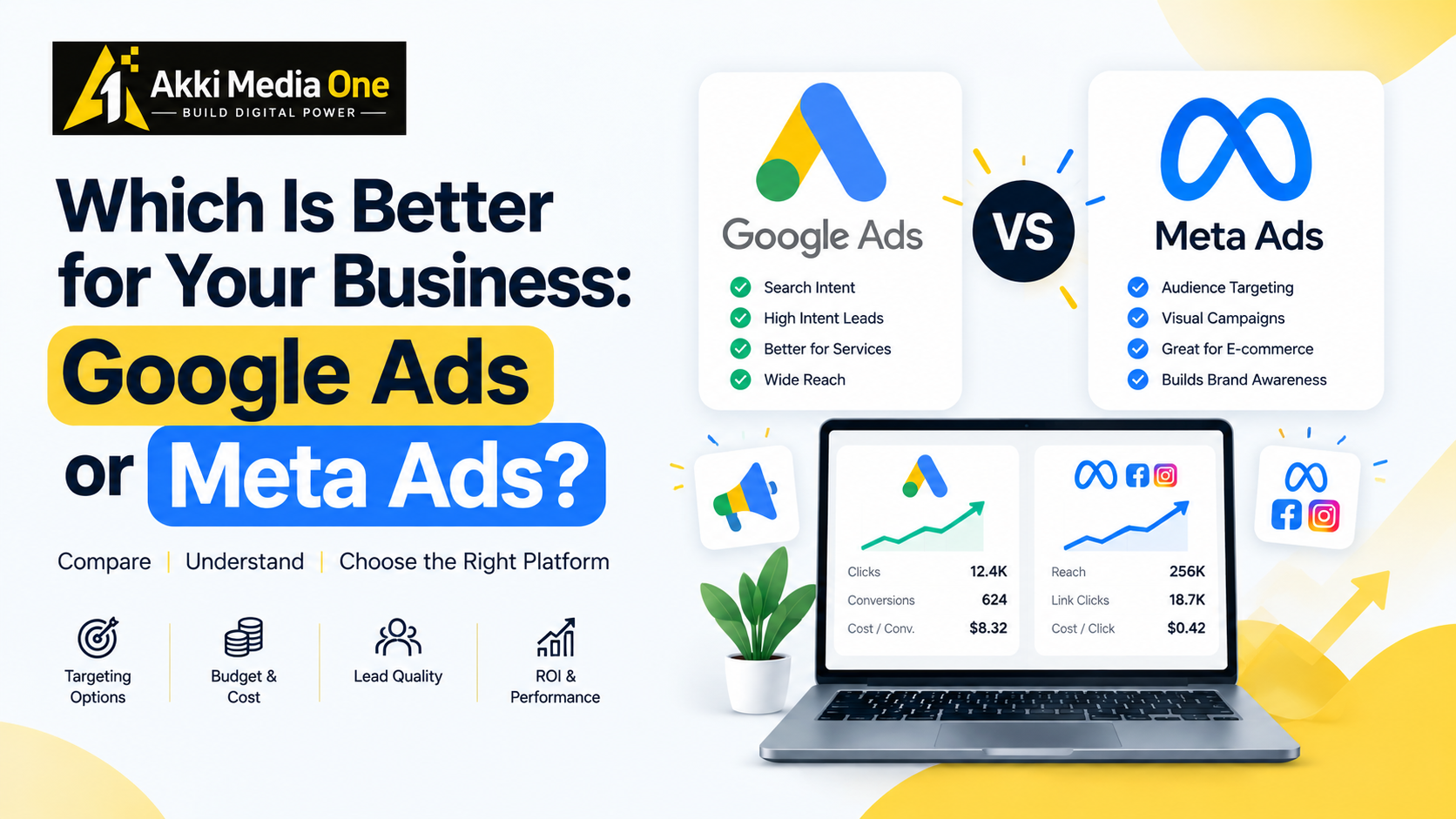
Which Is Better for Your Business: Google Ads or Meta Ads?
Published: 28 Oct 2026
On this page
Which Is Better for Your Business: Google Ads or Meta Ads?
Choosing the right advertising platform can make a significant difference to your business's online marketing performance. Two of the most widely used options are Google Ads and Meta Ads, which allow businesses to reach potential customers through different advertising approaches.
But which platform is better for your business?
The answer depends on what you sell, who your customers are, how they discover products or services, your budget, and your business goals.
Google Ads can help businesses reach people actively searching for products, services, or solutions. Meta Ads can help businesses reach audiences through platforms such as Facebook and Instagram based on available targeting options and campaign objectives.
In this guide, Akki Media One compares Google Ads and Meta Ads, explains their differences, and shows you how to choose an advertising strategy based on your business needs.
1. What Are Google Ads?
Google Ads is Google's online advertising platform. Businesses can use it to promote products and services across eligible Google advertising placements, including Google Search, YouTube, and other supported networks.
One of its key advantages is the ability to reach users based on their search queries when using Search campaigns.
For example, someone searching for “emergency plumber near me” may already need a plumbing service. A relevant Search ad can help a plumbing business reach that person at the moment of demand.
Google Ads offers several campaign types, including:
-
Search campaigns: Show text ads in relevant Google Search results.
-
Display campaigns: Reach audiences through eligible websites and apps.
-
Video campaigns: Advertise through YouTube and other eligible video placements.
-
Shopping campaigns: Promote eligible products using product information.
-
App campaigns: Promote mobile applications across supported placements.
-
Performance Max campaigns: Use Google's automation to serve ads across eligible Google inventory.
The campaign types and available features depend on eligibility, account settings, and Google's current advertising policies.
When Can Google Ads Be Useful?
Google Ads can be a strong option when:
-
People are already searching for the products or services you provide.
-
You want to generate enquiries from users with a specific need.
-
Your business serves a defined location or market.
-
You want to test demand for particular products or services.
-
You need to measure actions such as calls, purchases, and form submissions.
However, performance depends on factors such as keyword competition, search demand, ad relevance, landing page quality, bidding strategy, and conversion tracking.
2. What Are Meta Ads?
Meta Ads is Meta's advertising platform, which supports advertising across eligible placements on Facebook, Instagram, Messenger, and other Meta properties.
Businesses can use different formats and campaign objectives to introduce products, build awareness, generate leads, encourage engagement, and drive sales.
For example, a clothing brand can show product videos to relevant audiences on Instagram, while a local restaurant can promote its menu and offers to potential customers in its service area.
Common Meta advertising formats and approaches include:
-
Image ads: Present a product, offer, or service visually.
-
Video ads: Demonstrate products, explain services, or tell a brand story.
-
Carousel ads: Showcase multiple products or features in a single ad unit.
-
Lead ads: Collect customer information through supported lead forms.
-
Sales campaigns: Optimize for purchases or other configured conversion events.
-
Retargeting: Reach eligible audiences based on supported interactions and tracking signals.
Available targeting options, placements, and campaign features can change over time.
When Can Meta Ads Be Useful?
Meta Ads can be a strong option when:
-
Your product or service benefits from visual presentation.
-
You want to introduce your business to potential customers.
-
Your audience spends time on Facebook or Instagram.
-
You want to test different creatives, offers, or messages.
-
You want to generate leads or promote products using suitable campaign objectives.
Meta Ads can also generate high-intent leads in some situations. Its usefulness is not limited to brand awareness or impulse purchases.
3. Google Ads vs. Meta Ads: Key Differences
The main difference is how each platform helps businesses reach potential customers.
Google Search advertising can capture existing search demand. Meta advertising can help businesses reach audiences through discovery, interests where available, creative content, and other supported targeting signals.
These approaches can overlap, and neither platform is automatically better for every business.
|
Comparison |
Google Ads |
Meta Ads |
|---|---|---|
|
Main opportunity |
Capture relevant search demand and reach users across Google inventory |
Discover and reach audiences across Meta placements |
|
Search intent |
Search campaigns can target relevant queries |
Ads generally appear based on campaign delivery and audience signals rather than an explicit Google-style search query |
|
Creative formats |
Text, image, video, product formats, depending on campaign type |
Image, video, carousel, lead forms, and other supported formats |
|
Audience targeting |
Keywords, locations, audiences, and other campaign-specific signals |
Audience controls, locations, custom audiences, and other supported options |
|
Lead generation |
Search leads, calls, and website enquiries |
Lead forms, website enquiries, messages, and other supported conversions |
|
E-commerce |
Search, Shopping, Performance Max, and other eligible campaign types |
Product-focused and sales campaigns across eligible placements |
|
Measurement |
Conversion tracking and campaign reporting |
Meta Pixel, Conversions API, and supported campaign reporting |
|
Main challenge |
Competition, search demand, and cost per click |
Creative performance, audience response, and conversion quality |
The comparison is general. Actual capabilities depend on the campaign type, account, region, and current platform features.
4. Which Platform Is Better for Different Business Types?
There is no universal winner. The best choice depends on the way customers discover and evaluate your offer.
Local Service Businesses
Examples include plumbers, electricians, repair services, dentists, and professional consultants.
Google Search Ads may be a good starting point when customers actively search for the service and relevant search volume exists.
Meta Ads may help when the business needs to build awareness, promote an offer, or reach local audiences who may need the service in the future.
Practical approach: Start with the platform that best matches customer demand and test the alternative when the budget and tracking setup allow it.
E-commerce Businesses
Online stores can benefit from both platforms.
Google Ads may help capture product-related searches and reach users researching specific products. Meta Ads may help showcase products through creative campaigns and reach relevant audiences.
For a store selling visually distinctive products, video and carousel advertising can be particularly useful for communicating product features.
Practical approach: Evaluate purchases, revenue, contribution margin, and customer acquisition cost instead of comparing clicks alone.
B2B Businesses
Businesses selling software, consulting, professional services, or industrial products often need to consider the length and complexity of their sales cycle.
Google Search Ads may reach users searching for a specific business solution. Meta Ads may support awareness, retargeting, or selected lead-generation campaigns, depending on the target audience.
Practical approach: Measure qualified enquiries, meetings, sales opportunities, and closed deals rather than optimizing only for form submissions.
Restaurants and Local Retailers
Google Search Ads may help reach customers looking for nearby restaurants, products, or services. Meta Ads may be useful for promoting new menus, special offers, events, and visually appealing products.
For restaurants, the right campaign also depends on whether customers order online, visit the premises, or make reservations.
Practical approach: Track meaningful outcomes such as orders, calls, directions, bookings, and in-store visits where reliable measurement is available.
5. Google Ads vs. Meta Ads: Which Is More Affordable?
One of the most common questions businesses ask is which platform costs less.
There is no fixed answer.
Advertising costs vary by industry, country, audience, competition, campaign objective, creative quality, bidding strategy, and conversion performance.
Google Search campaigns operate in an auction where relevant factors influence ad delivery and costs. Meta Ads also uses an ad auction, with delivery influenced by factors such as the campaign objective, audience, budget, and estimated ad performance.
A cheaper click does not necessarily mean a cheaper customer.
Consider this illustrative example.
|
Metric |
Campaign A |
Campaign B |
|---|---|---|
|
Advertising spend |
$500 |
$500 |
|
Clicks |
500 |
1,000 |
|
Enquiries |
25 |
20 |
|
Cost per enquiry |
$20 |
$25 |
In this example, Campaign B generates more clicks, but Campaign A generates more enquiries at a lower cost per enquiry.
These figures are hypothetical and are used only to explain the calculation. They are not industry benchmarks or promised results.
Before deciding which platform is more affordable, compare:
-
Cost per qualified lead.
-
Cost per customer acquired.
-
Conversion rate.
-
Average order value.
-
Profit margin.
-
Revenue generated relative to advertising spend.
The platform with the lowest cost per click may not be the platform that delivers the best business results.
6. Which Platform Generates Better Leads?
Lead quality depends on more than the advertising platform.
It is influenced by your audience, offer, targeting, ad message, landing page, qualification process, and follow-up.
Google Search Ads may generate strong leads when the user searches for a relevant service and the ad accurately addresses that need.
Meta Ads may generate strong leads when the creative, offer, and audience match the customer's needs. However, some lead campaigns may attract people who are interested but not ready to purchase.
To improve lead quality on either platform:
-
Clearly explain the product or service.
-
Use advertising messages that accurately represent the offer.
-
Direct visitors to a relevant landing page or lead form.
-
Ask appropriate qualification questions without making the process unnecessarily difficult.
-
Follow up promptly with genuine enquiries.
-
Track which leads become sales.
-
Use reliable conversion data to improve campaign decisions.
Important: A campaign that generates many inexpensive leads is not necessarily successful if those leads rarely become customers.
7. How to Calculate Advertising ROI
Return on advertising spend (ROAS) measures the revenue attributed to advertising relative to the advertising cost.
The formula is:
ROAS = Attributed Revenue ÷ Advertising Spend
For example, if a campaign generates $3,000 in attributed revenue from $1,000 in advertising spend:
ROAS = $3,000 ÷ $1,000 = 3
That is a 3:1 ROAS.
However, ROAS is not the same as profit or overall return on investment. It does not automatically account for product costs, salaries, agency fees, shipping, taxes, or other expenses.
For a more complete business assessment, consider:
-
Gross profit from the attributed sales.
-
Advertising spend.
-
Agency or management fees.
-
Cost of goods or service delivery.
-
Other relevant operating costs.
-
The reliability of the attribution method.
For lead-generation businesses, measuring customer acquisition cost and the revenue or profit generated by converted leads may be more meaningful than measuring ROAS alone.
8. Should You Use Google Ads and Meta Ads Together?
In many cases, yes. The platforms can serve complementary roles in a marketing strategy.
A business might use Google Search Ads to reach people actively looking for a solution and Meta Ads to introduce its services to relevant audiences or reconnect with eligible previous visitors.
For example, a website development agency could:
-
Use Google Search Ads to target relevant website development searches.
-
Use Meta Ads to showcase genuine project examples.
-
Publish educational blog content to attract organic traffic.
-
Use permitted remarketing methods where tracking, consent, and platform policies allow.
-
Measure qualified enquiries and actual sales across its marketing activities.
However, running both platforms does not automatically improve performance. A combined strategy requires appropriate budgets, distinct campaign objectives, reliable tracking, and enough data to evaluate results.
If the budget is limited, it may be better to test one suitable channel first rather than spread the budget too thinly across multiple campaigns.
9. How to Choose the Right Advertising Platform
Before launching a campaign, answer these questions.
Step 1: Define Your Business Goal
Are you trying to generate enquiries, sell products, increase bookings, promote an app, or build brand awareness?
Choose a campaign objective that matches the outcome you actually want.
Step 2: Understand Customer Behaviour
Do your potential customers actively search for your solution, or do they need to discover your brand first?
If strong relevant search demand exists, Google Search Ads may be worth testing. If your offer is highly visual or benefits from audience discovery, Meta Ads may be a useful option.
Step 3: Calculate Your Budget
Decide how much you can afford to spend while testing your campaign.
Account for the advertising budget separately from creative production, landing page development, agency management, and other costs.
Step 4: Prepare Your Landing Page
Ensure that your page explains the offer, answers important questions, works well on mobile, and provides a clear next step.
A weak landing page can reduce the effectiveness of advertising on either platform.
Step 5: Set Up Conversion Tracking
Track meaningful actions such as purchases, qualified enquiries, booked appointments, and completed forms.
Verify that tracking works correctly before using the resulting data to make decisions.
Step 6: Evaluate the Results
Compare the quality and cost of outcomes, not just impressions or clicks.
Give the campaign an appropriate testing period, consider the sales cycle, and avoid drawing conclusions from insufficient data.
10. Common Advertising Mistakes to Avoid
|
Mistake |
What to Do Instead |
|---|---|
|
Choosing a platform based only on popularity |
Match the platform to customer behaviour and business goals |
|
Comparing cost per click alone |
Compare qualified leads, customers, and profit |
|
Running ads without conversion tracking |
Verify tracking before evaluating performance |
|
Sending all traffic to the homepage |
Use relevant landing pages where appropriate |
|
Changing campaigns too frequently |
Allow enough time and data for meaningful evaluation |
|
Expecting guaranteed results |
Set realistic targets and test your assumptions |
|
Ignoring lead follow-up |
Build a clear process for contacting and qualifying prospects |
11. Frequently Asked Questions
Q1. Which is better for small businesses: Google Ads or Meta Ads?
Both can work for small businesses. Google Search Ads may be useful when customers actively search for the service, while Meta Ads may help with audience discovery, visual promotion, and lead generation. The better option depends on the offer, market, budget, and conversion results.
Q2. Are Meta Ads cheaper than Google Ads?
Not necessarily. Costs vary by industry, location, audience, campaign objective, and competition. Compare the cost of qualified leads or acquired customers instead of assuming that one platform is always cheaper.
Q3. Which platform is better for lead generation?
Both platforms can generate leads. Google Search Ads can capture existing demand, while Meta Ads can reach audiences through its advertising placements and targeting capabilities. Lead quality depends on campaign setup, the offer, qualification, and follow-up.
Q4. Can I run Google Ads and Meta Ads at the same time?
Yes. Businesses can use both platforms when they have clear objectives, appropriate budgets, reliable conversion tracking, and a way to evaluate performance. A combined strategy is not automatically better for every business.
Q5. How much should a business spend on advertising?
There is no universal minimum budget that guarantees results. Start with an amount your business can afford to test, estimate the economics of acquiring a customer, and review campaign performance before scaling.
Q6. How do I know whether my ads are profitable?
Track the revenue and costs associated with acquired customers. For e-commerce, ROAS can be useful, but profit margins and other costs must also be considered. For lead generation, measure qualified leads, sales conversion rates, customer acquisition cost, and revenue.
Conclusion
Google Ads and Meta Ads offer different ways to reach potential customers, and neither platform is automatically the best choice for every business.
Google Ads can be particularly useful for capturing relevant search demand. Meta Ads can be useful for audience discovery, visual storytelling, and targeted campaigns across Facebook and Instagram.
The right decision depends on your customers, business model, budget, campaign objectives, and ability to measure meaningful outcomes.
Rather than choosing a platform based on assumptions, define your goals, test a suitable strategy, track conversions, and evaluate the quality and profitability of the results.
Need help choosing an advertising strategy for your business?
Akki Media One provides digital marketing and advertising services to help businesses develop a suitable online growth strategy.
Explore our website: https://akkimediaone.com/
Official Sources and Further Reading
-
Google Ads Help — https://support.google.com/google-ads/
-
Google Ads — https://ads.google.com/
-
Meta for Business — https://www.facebook.com/business/
-
Meta Ads Guide — https://www.facebook.com/business/ads-guide
-
Google Analytics Help — https://support.google.com/analytics/
Why This Topic Matters
This article is designed to give direct, useful answers that business owners and marketing teams can apply in real projects. For broader execution support, explore our services, review our portfolio, or talk to our team.
About The Publisher
Akki Media One publishes practical guidance on SEO, paid ads, website development, digital strategy and business growth. Our content is written to support decision-making, implementation and measurable outcomes.
Quick Answers
What is the main takeaway from Which Is Better for Your Business: Google Ads or Meta Ads??
Which Is Better for Your Business: Google Ads or Meta Ads? Choosing the right advertising platform can make a significant difference to your business's online marketing performanc...
Who should read this article?
Business owners, marketing teams and growing brands looking for practical SEO, content, ads or web growth guidance.
What should I do next after reading this?
Review related articles, explore relevant services and contact our team if you need implementation support.